


 By
Biko Rading
By
Biko Rading
In rural Kenya, most women use a hoe for their agricultural activities, a default sign of agriculture. This portrays a depilated farming activities that women on the continent face. In Africa 70 per cent of food is grown by women who are smallholder farmers.
The continent’s population is expected to double by 2050, meaning it will require enormous effort to feed the people.
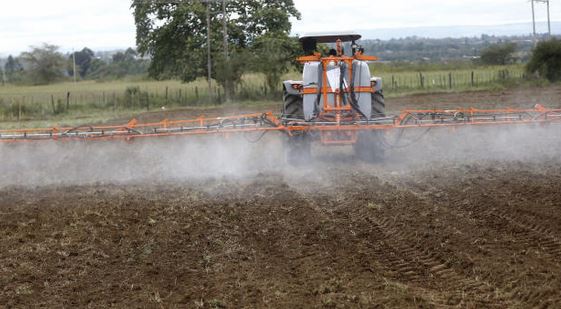
Experts suggest that its time the continent ditch the hoe in favour of
modern technology, which will complete the same tasks far more
efficiently.
Recently at a high-level lecture to an international audience of the Jomo Kenyatta University of Agricultural Technologies by Dr Kaumbutho, Managing Director, Agrimech Africa Limited pointed out ways in which Youthful Entrepreneurs can enter Kenya’s Agricultural Mechanisation sector and make a great business of it.
“A country where there are, only 2 tractors for every 2500 acres (equivalent to 8 tractors for the entire Del Monte 10,000-acre farm in Thika) and some 70 per cent idle productive agricultural land food security will soon depend on expensive food imports. In a continent whereby 2030 the Agribusiness economy will be worth US$ 1 Trillion, Kenyan youth need to keep their eyes and innovative prowess around the agriculture sector,” says Dr Kaumbutho.
At the moment mechanisation levels on farms across Africa are very low, with the number of tractors in Sub-Saharan Africa ranging from 1.3 per square kilometre in Rwanda to 43 per square kilometre in South Africa, compared with 128 per square kilometre in India and 116 per square kilometre in Brazil.
- READ MORE
- 11 kitchen garden ideas for gardeners with tiny spaces
- Kienyeji chicken almost broke my love for business
- No more food aid for Turkana herders who have embraced farming
- Ainamoi women ditch changaa brewing for tea farming
According to the Food and Agriculture Organisation (FAO), a UN specialized agency that champions efforts to defeat hunger, Africa overall has less than two tractors per 1,000 hectares of cropland. There are 10 tractors per 1,000 hectares in South Asia and Latin America.
Without mechanized agriculture, productivity suffers drastically,
lowering farmers’ earnings, notes the Alliance for a Green Revolution
in Africa, an organization funded by the Bill & Melinda Gates and
Rockefeller Foundations that seeks to promote agricultural
transformation and improve food security in Africa.
Dr Kaumbutho adds that to bring about the needed change in agriculture
there is a need to focus our energy more on developing and creating an
enabling environment for rural Kenya to grow as the nature of the new
growth in Kenya is one that is inclusive and opens up the rural economy.
It would be unthinkable and counterproductive, to think of
developing agriculture in Kenya by continuing to use the orthodox means
of farming and low yielding agricultural paraphernalia. Conservation
Agriculture (CA) progresses from the much-promoted principles of its
actualization, (Minimum Soil Disturbance, Crop Rotations and
Associations and Permanent Soil Cover).CSA promotes diversification and
its links to production efficiency and recycling,co-creation and
sharing of knowledge around human and social values and culture and food
traditions. The post-COVID-19 and the recurrent droughts and floods,
current locust infestations and other disasters, responsible governance,
towards circular and solidarity economy will be paramount and
essential.”
The don also highlighted the undertakings his company is putting in
place, anticipating the acceleration - funding support of USADF and BMZ,
to establish inclusive farm power pooling and digitized mechanization
services.
“Agricultural Mechanization Services Hubs (AMSH) business model take deeper root and spread faster, to make CA and CSA workable. The Hubs will make land-use consolidation possible, empowering smallholders to remain at the centre of production value-chains as youth take-on mechanization, with ease, to remove farming drudgery from the over-burdened lives of smallholder farmers,” comments Dr Kaumbutho.
Africa currently spends a whopping $35 billion annually on food
imports, according to the African Development Bank (AfDB), which
projects that if the current trend continues, food imports could rise to
$110 billion by 2050.
Recently AfDB President Akinwumi Adesina noted that “Technologies to
achieve Africa’s green revolution exist but are mostly just sitting on
the shelves. The challenge is a lack of supportive policies to ensure
that they are scaled up to reach millions of farmers.”
Dr Kaumbutho insists that Kenya can feed the rest of the horn of Africa and the sub-Saharan region the government invests heavily in agricultural mechanization.
No comments :
Post a Comment