


 Interview
By Juanita Williams
Interview
By Juanita Williams
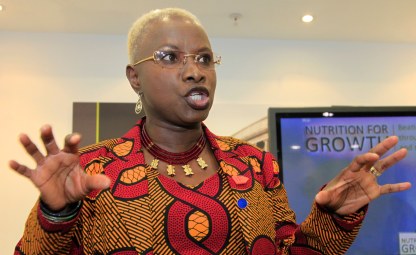
Cape Town — AllAfrica's Juanita Williams spoke with musician and activist Angelique Kidjo about her latest role in an African Development Bank and G7 collaboration, Affirmative Finance Action for Women in Africa (AFAWA) - a pan-African initiative to bridge the $42 billion financing gap facing women in Africa.
Your commitment to development for women and girls is very well known, especially your Batonga Foundation. Why did you choose to be involved with the Affirmative Finance Action for Women in Africa?
I've been working with young girls, children and women since 2002 since I became UNICEF Goodwill Ambassador
and throughout the years, I realised that even at that young age young
girls and women are resilient because they go through so much on a daily
basis. I have been putting young girls through school and when you
finish a cycle and want to get to work, there is no financial
institutions that are willing to give them any help to get there. I
think that the women of Africa are really among those human beings on
this planet that can move the needle.
The fact that all
the institutions - all banking institutions - don't consider women in
rural areas or those working in markets as clients, as potential game
changers, is something that struck me because here I am spending money,
fundraising to put girls through secondary education, tertiary education
and when they finish and they want to start a business. And if they do
not have funding and do not have collateral they cannot do anything. So
why are we investing in those women if in the long run they cannot have a
family in which they can participate planning financially, to raise
their kids and put meals on the table for their families and also send
their children to school, and really make a dent in poverty. We can only
stop the cycle of poverty by educating, and the continuation of
education is financial inclusion.
How does AFAWA plan to tackle the challenge that women face in order to have access to finance?
AFAWA is the
initiative of the African Development Bank and the first thing that it
plans to do is to leverage the African fund to guarantee the loan and
technical assistance which will provide advisory service to financial
institutions to ensure successful implementation of their products for
women, and strengthen also the relationship with the women in the
market. And to inform bank workers to explain to those women how to do a
business plan. They already understand money, they can make money and
how they can grow the business. If they have small businesses that they
are willing to grow the bank can help them by training them and training
people in the bank to do banking differently for those women. The third
pillar of AFAWA
is an enabling environment which will engage African governments and
other key stakeholders to support legal policies and regulatory reform
because we still have old work model that impact the women, women have
the right to choose for their own what they want. We need to change the
mentality and we need the government in Africa to realise the financial
potential that the women can unleash in in their countries which will
reduce poverty.
You
mentioned the government and I'm assuming that the private sector would
need to be involved in this, and of course because that is the banking
sector. What do they need to do and how is AFAWA going to approach the
private sector especially? I think that government are open to AfDB
projects but the private sector has been a stumbling block.
They are a
stumbling block because first of all it cost more money to manage small
loans than big loans, so what we have to do is to convince the private
bag and a commercial bank that when they give a loan there is a
guarantee that is what the G7 fund that has been raised will do is a
guaranteed fund that will guarantee the loan they will give that it
doesn't have any risk to take for them at all, its just benefits.
Because the women will pay back and if they pay slowly or they don't pay
back, they will still get the money, there's no risk for them to take
just to start. And I think I can guarantee you that if it were common to
do this, and they then start seeing how the women are developing, they
are going to embrace it totally and find different ways to implement
that everywhere.
The challenge will
be in the rural areas where there is not banking system but if it
starts working in cities and we start seeing the success and the profit
they are making the bank will start will investing in rural areas
because you lead by example and you lead by resource. We don't have to
talk too much, we have to act. We have to try this at least to make sure
that women are credit worthy. That women are partners and they don't
need help, they don't need aid, they need partnership in return. They
need to be respected and to be trusted in their ability to do business
and it needs to be understood that investing in their business and
working with banks will give them more leverage, more power and in
return they will create jobs in their communities. And the job they are
creating will bring potential clients for the banks.
You speak about all the different factors and hurdles that women face in your guest column that AllAfrica published.
There's so many interlinking issues on the continent - the security
problem, the climate crisis, gender issues. How do they relate to each
other in terms of empowering women, for want of a better term?
All the things you
listed are based on poverty, poverty is the bedrock of challenges,
crisis, war of all kinds, of abuse because the abuser is poor.
To stop the cycle of poverty, women when they start creating jobs. the
way African women think is the way all women think, we cherish, we
value, we protect and we love our families and we want the best for our
children also want the best for our husbands so if they have financial
inclusion they have access to money to create jobs and security will
come in. I will tell you one thing that really strikes me in all my
trips all around the world. Ten years ago we took a trip to Chad in the
refugee camp of the Sudanese refugees. We asked to meet some women
because we heard that those women that have been raped in the camp when
they go out to get wood to cook they get raped again by the same men. We
wanted to hear what was happening there and when the women started
speaking it made my commitment to women get strengthened even more. I
lost my ability to sleep easily because of the horror that we put
African women through. In that defining and profound moment of emotion,
of pain, of anger we just could not understand why and how can we find
solutions and the woman said to us whatever you do when you leave this
place we want you to lobby for us to go back to our country in safety
and security to start our businesses to able to feed our children, to be
able to put our girls and boys to school because in this camp where we
have come to realise that through education we can stop violence. We do
not want to be perceived as victims.
These are women
whose husbands have been killed, children have been killed and they are
still thinking positively and still thinks if she has a better financial
help she could have a better life which means nothing can stop our
conflicts if our women are not included financial into our systems, that
is the only way we can have peaceful countries. That is the only way we
can transform completely our continent without having people always
telling us we will help. We are able to help the rest of the world but
to help the rest of the world we need to empower at least our women out
of poverty that is the only way we will stop immigration, our children
from dying in small boats and smugglers to cut the business of smuggling
and human trafficking. All of this is possible through women inclusion
because if mothers are striving to do good boys and girls will want to
do better because of the horror that the women have been through they
will start raising boys and girls differently because now they have the
means to sit them down and say "today I have access to money and I want
to put it through to school and I want you to understand is that it is
not your agenda that defines who you are and if you work hard you can
succeed".
When you
say that it is not gender that defines who you are, for a lot of women
on the continent it does actually define what they are allowed to do,
what they are not allowed to do with their health, etc, specifically
because they are women. You sound really passionate and I'm with you on
how strong African women are and how strong women are in general,
especially when it comes to overcoming these obstacles. But the
patriarchal society that we live in is real. Is financing the key that
is going to help unlock and remove all these obstacles?
The thing that I
always say is that finance is a really profound and big part of the
problem and also education because I realised since I started my Batonga Foundation
that some girls don't just need to go to academic school and learn
about history and geometry, there are different ways to educate so we
should plus the financial inclusion. We should think about our society
differently. So far our education system is covering up the education
system of the West but our societies are different, for me training
women to understand how banks function is important, training women
about sanitation is important and training women about gender issue is
important.
You don't need to
go to school to learn that. Vocational training has to be at the centre
of our education system in rural areas and even in cities. We have to
sit women and men down to talk about gender equality, we can't just do
conferences everywhere and talk about gender equality. We have been
talking about gender inequality for a while and nothing is changing.
How do we come
with solutions? If you are a mother all your effort when you wake up in
the morning is how to make ends meet, how am I going to finish today and
put a meal on the table, and how am I going to pay my debt because
women have been put through so much debt that they spend most of their
energy trying to pay back the debt. And if they cannot pay back the
debt, they cannot sleep. How can we engage any woman about gender
equality? How can she even see herself as a victim of the society of
patriarchy? If she has money, she can put the child to school and she
can go to a meeting and she can have a say and say what she wants for
her life and men will stick with them and listen because the symptoms of
scarcity is one that is killing us because when you do not have food.
All your energy
goes towards this because you have a tunnel vision. Any issue does not
matter because it is your survival, therefore we need financial
empowerment to give women the voice and raise their boys differently.
Telling the boy that you are sending him to school not because you are
more important than your sister but you both have equal rights under my
roof.
But if everyday
you wake up just to struggle even if you know deep down in your soul
that what you should be doing you don't have time to be doing that
because you want your family to eat. Some of the women in the market in
my country say their husbands lost their jobs and it becomes another
burden on women's shoulders and they have to end up having to find money
to feed their kids and their husbands. Everything just falls on the
shoulder of a woman. Every issue we are talking about if women could sit
down and read knowing that if they start a business they will have the
help of a bank as a partner. And they can sit down with those banks and
decide how long the loan will be and how much they will pay. If they
cannot pay at that rate they can come back and sit with the bank and say
"I cannot pay that much" and if the bank can be flexible in 10 years we
may not be talking about gender equality as it is anymore end violence
against women will decreased because the frustration of a man that has
no job, in a patriarchal world we live in the men are the ones that
bring the bread to the table now we need to change the narrative. My
grandmother used to say to me "don't be a weight on a shoulder of a man,
being married to somebody is a partnership, bring yours on a table,
your first husband has to be your job."
When my grandmother
was telling me that I did not understand the scope of the things she
was telling me. She said "After I became a widow, I refused to marry the
closest kin to your grandfather's family. I was left alone to fend for
myself and had to work, if my sister didn't accept to give me a place in
her house, where would I be?"
It really struck me what you said about partnership because hopefully AFAWA will move towards women having partnerships with banks rather than it being a top down ..
For me that is what
I'm thinking that is what I'm bringing to the table because top down
doesn't work. Because if you didn't respect those women it won't work. I
come from a family where I have two grandmothers who were widowed very
early and they have the same fate. Because she's never been to school it
doesn't know how to read or write but she understands money. My father
convinced her at one point to open a bank account.
She said "Okay,
I'll do it" and after a year should close the bank account, telling my
father: "I don't want to be part of that." He asked her why she did it -
she said when she opened my bank account there was a red carpet, "but
when I come to take money out and invest my money better, I'm treated
like a thief and a nobody, so therefore my money is staying with me."
She then stuck the money in her closet and when she died all the money
was eaten by moths. What a waste all her life's savings, because there
was no trust with the bank, she lost everything!
My AllAfrica colleagues would not forgive me if I didn't ask about plans for new music. And you are nominated for a Grammy again this year in the World Music category (for Celia). In the past you've had some thoughts about that category.
It's just human
nature to put labels on things and I think we have to evolve out of that
and give credit to the people that can understand and choose what they
would like to do without putting labels on anything that is what the
world music category comes from. If we African musicians are world
artists, what are the other artists? Which planet do they come from?
The thing about
the Grammys is that they are open enough to welcome every music, they
represent the music of all this world. There are categories that are
probably not there but they are trying their best to be an academy that
represents every culture and I'm very grateful for that. This year the
category is packed with talented people which is the good thing for me
to be being nominated next to all those talented young musicians. It's
always an honour for be nominated for the Grammys and let's see what
comes out of it. We Africans are in a defining moment
where our stories need to be told by us and differently. This young
generation of musicians are doing it so I'm grateful and proud to be
next to those musicians today.
Any parting words?
One thing I want
people to realise on the continent is that I am doing this and I am not
paid and I am not taking the money from anyone and I do not want that
because I want the women of Africa to succeed and I want my continent to
be seen differently. I want us Africans to tell our story, I want all
our tech to succeed. We can invent a lot of things to move forward to
change our society. That change is not that far, so we need the banks to
be partners. If you want to build stronger banks, if you want to
compete on a global level not just taking money from other people but
lending money to the rest of the world, not selling our land and our
wealth and other resources.
We need to keep
our resources for our future generation so therefore we need to empower
our women. We need to empower every child, every boy, every girl from
Africa to be proud of their countries, to be proud of their continent,
to the proud of the what they stand for, their culture because we have
impacted this world cultural in many different ways and we do not take
credit for it. I fight through my career every day to tell this story of
African people positivel. Not the short story or how people say how bad
Africa is. If Africa is bad that means the whole world is bad.
No comments :
Post a Comment