


Forget game theory, futurists, and cash-flow models: When it comes to product strategy in today’s auto industry, things need not be so complicated.
Just make some trucks, and Americans will buy them—lots of them.
It helps, of course, if you make a very good truck. Honda did just that when it rolled out a thoroughly redesigned version of its Ridgeline pickup in June 2016. Trailing a string of strong reviews, the carlike pickup has been hugely popular among people who buy trucks, and even among those who don’t.
“This is a very capable truck that meets the needs of a vast majority of buyers,” says Jeff Conrad, general manager of American Honda Motor Co. “For somebody who doesn’t care about towing 8,000 pounds ... it’s perfect.”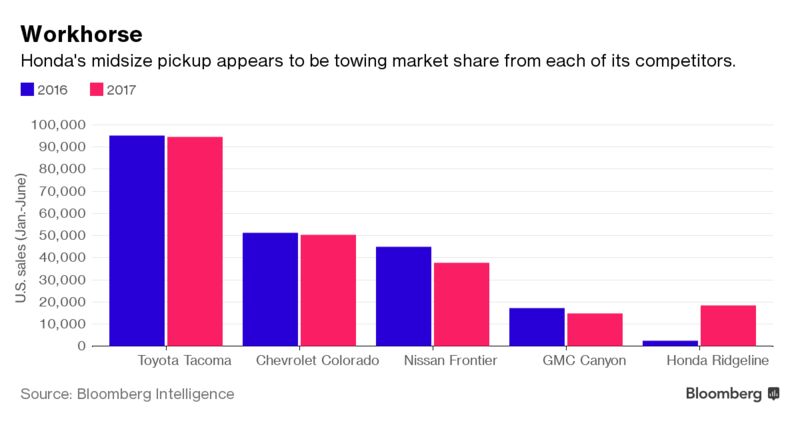
In the past 12 months, Honda has sold almost 40,000 Ridgelines in the U.S., accounting for one out of 10 vehicles in the midsize pickup segment. Not only did Honda swipe share from established rivals, but it appears to have brought in new buyers—drivers who traditionally were more inclined to buy an Accord than a Toyota Tacoma.
Conrad said Honda could have easily sold more trucks, but the Lincoln, Ala., plant where it welds them together is already operating at full capacity.
Of course, there’s a big gap in these sales statistics. Ford, the heavyweight champion of the truck game, hasn’t sold a midsize version in the U.S. since 2012. It didn’t want to cannibalize the perpetually stellar sales of its full-size F-150. Plus, it has a nifty line of vans to accommodate painters, plumbers, and other small business—at least that’s the justification former Chief Executive Officer Mark Fields offered a couple of years ago.
Ford has since changed tack. Sometime in 2019, it will unveil an “all-new” version of the Ranger, a little pickup it currently makes in Argentina, South Africa, and Thailand, and sells pretty much everywhere except the U.S. Mike Levine, head of product communications in North America, says this newest iteration of the truck, which used to sell in the U.S., will be built in Michigan.
Waiting two years to bring back the Ranger “is what works for us,” says Levine. “We’ve put the focus on F-Series today, including the F-150 ... making it more capable and also more fuel efficient.”
Ford may have to change its formula a bit if it wants to capture some of Honda’s appeal. Most notably, the Ridgeline features the so-called unibody construction that sedans get, giving it more of a feel for the road than most trucks, which have bodies that are bolted on to the frame.
While, the front of the Ridgeline is all
business—planted on the road—in the back, it’s a party. The tailgate
swings out horizontally, like a door, in addition to dropping down
traditionally. There’s a 400-watt outlet for plugging in something like a
large-screen television, a series of speakers in the bed, and a
compartment under the liner that just happens to be the size and shape
of a large cooler. Honda calls it an “in-bed trunk,” though perhaps with
a wink, because unlike most trunks, it has a drain.Just make some trucks, and Americans will buy them—lots of them.
It helps, of course, if you make a very good truck. Honda did just that when it rolled out a thoroughly redesigned version of its Ridgeline pickup in June 2016. Trailing a string of strong reviews, the carlike pickup has been hugely popular among people who buy trucks, and even among those who don’t.
“This is a very capable truck that meets the needs of a vast majority of buyers,” says Jeff Conrad, general manager of American Honda Motor Co. “For somebody who doesn’t care about towing 8,000 pounds ... it’s perfect.”
In the past 12 months, Honda has sold almost 40,000 Ridgelines in the U.S., accounting for one out of 10 vehicles in the midsize pickup segment. Not only did Honda swipe share from established rivals, but it appears to have brought in new buyers—drivers who traditionally were more inclined to buy an Accord than a Toyota Tacoma.
Conrad said Honda could have easily sold more trucks, but the Lincoln, Ala., plant where it welds them together is already operating at full capacity.
Of course, there’s a big gap in these sales statistics. Ford, the heavyweight champion of the truck game, hasn’t sold a midsize version in the U.S. since 2012. It didn’t want to cannibalize the perpetually stellar sales of its full-size F-150. Plus, it has a nifty line of vans to accommodate painters, plumbers, and other small business—at least that’s the justification former Chief Executive Officer Mark Fields offered a couple of years ago.
Ford has since changed tack. Sometime in 2019, it will unveil an “all-new” version of the Ranger, a little pickup it currently makes in Argentina, South Africa, and Thailand, and sells pretty much everywhere except the U.S. Mike Levine, head of product communications in North America, says this newest iteration of the truck, which used to sell in the U.S., will be built in Michigan.
Waiting two years to bring back the Ranger “is what works for us,” says Levine. “We’ve put the focus on F-Series today, including the F-150 ... making it more capable and also more fuel efficient.”
Ford may have to change its formula a bit if it wants to capture some of Honda’s appeal. Most notably, the Ridgeline features the so-called unibody construction that sedans get, giving it more of a feel for the road than most trucks, which have bodies that are bolted on to the frame.
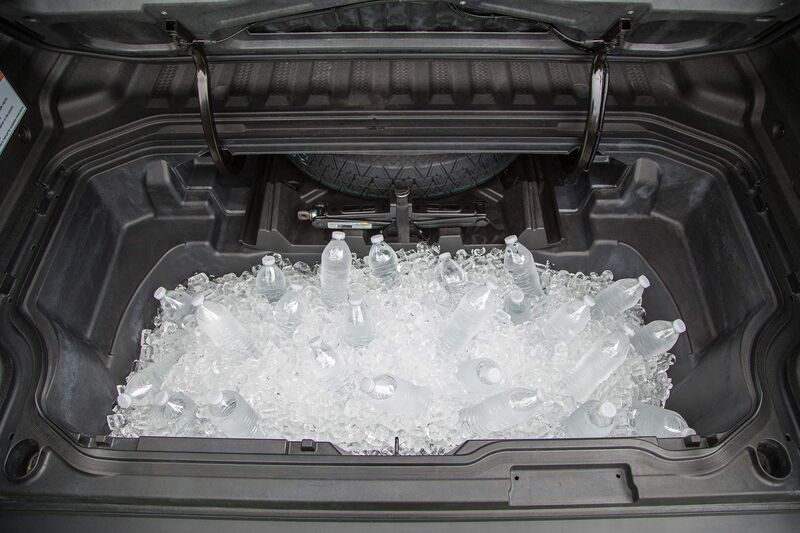
The Ridgeline's “in-bed trunk” for your refreshments.
Source: Honda
No comments :
Post a Comment