


 The Guardian
The 2026 Asia Power Index positions India as Asia’s third-most-powerful nation, reflecting its growing diplomatic, cultural, military and economic influence. With Hon’ble Prime Minister Modi ranked second in leadership effectiveness, expanding
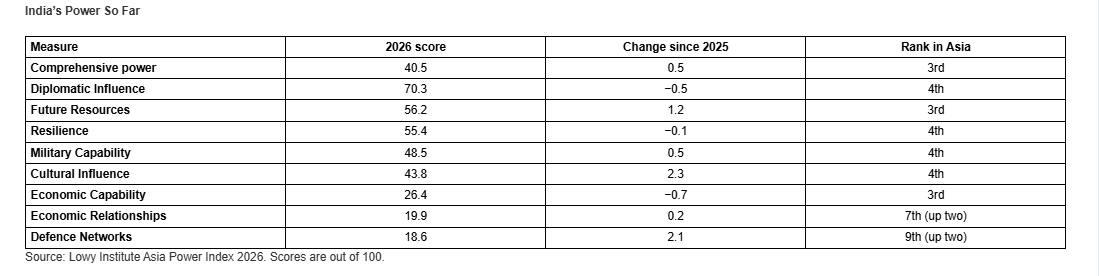
defence networks and stronger future resources, India is increasingly translating its capabilities into strategic regional leadership.India is now the third most powerful country in Asia, and its distance from China is the narrowest ever recorded. This is the principal finding on India in the Lowy Institute’s 2026 Asia Power Index. India’s overall score rose by 0.5 points to 40.5, securing its place among the region’s major powers. In the same assessment, Hon’ble Prime Minister Sh. Narendra Modi was rated the second most effective leader in Asia, after India advanced three places on that indicator. These conclusions come from one of the region’s most closely watched measures of strategic weight, and they were reached in a year when most reputations declined.
The Asia Power Index, published annually since 2018 by the Sydney-based think tank Lowy Institute, scores 27 countries and territories across 131 indicators. These indicators are organised into eight measures: four of resources (Economic Capability, Military Capability, Resilience and Future Resources) and four of influence (Economic Relationships, Defence Networks, Diplomatic Influence and Cultural Influence). The Index assesses both what a country possesses and how effectively it converts those assets into influence. Because scores are relative, a country advances only by outperforming the field.
The circumstances of 2026 gave India’s result added significance. The conflict in the Gulf disrupted energy and fertiliser supplies, tariffs proliferated, and the United States redirected military resources towards the Middle East. Against that backdrop, the United States recorded the largest decline in diplomatic influence in the Index’s history. Indonesia lost 5.5 points, and Japan, South Korea and Australia each lost diplomatic ground. India’s diplomatic score moved by half a point to 70.3. India advanced because it held steady while others did not, and constancy under pressure is itself a source of strategic power.
India improved its score in five of the eight measures: Future Resources, Military Capability, Cultural Influence, Economic Relationships and Defence Networks. It holds a position among the top four in Asia in six of them. This pattern matters because the Index rewards consistency across resources and influence alike, and few countries in the region combine a strong material base with a widening external reach. India's two advances in rank, on Economic Relationships, where it rose two places to seventh, and on Defence Networks, where it rose two places to ninth, are especially significant. These measure how deeply a country is integrated into its region through trade, investment, economic diplomacy and security partnerships. Gains in these dimensions indicate that India's influence is no longer confined to its capabilities but is increasingly embedded in the relationships of its neighbours.
The leadership ranking has clear and consequential implications. Expert ratings of leaders do not count ships, exports or reserves. They measure confidence, specifically the extent to which a government's word carries weight in forums where it is not present. Expert appraisals of Prime Minister Modi's regional leadership improved markedly in 2026, lifting India three places on that indicator and placing him second among the region's leaders. The Index observes that Southeast Asian states are likely to diversify their trade and security partnerships to hedge against the unpredictability of United States policy. For states recalibrating their partnerships in this manner, a capital perceived as steady, purposeful and consistent in its commitments is a valuable interlocutor. The 2026 ratings indicate that India is increasingly regarded in precisely this light.
The gains in cultural standing reinforce this conclusion. Cultural Influence delivered India’s largest improvement of the year, rising 2.3 points to 43.8, with progress recorded in cultural projection, information flows and people exchanges alike. This is the slowest measure to build and the hardest to direct by policy, which is precisely what makes it informative. It reflects students drawn to Indian universities, audiences following Indian media, and the reach of the Indian diaspora. This kind of influence precedes policy and tends to outlast it.
India’s progress in security partnerships is equally notable. Its Defense Networks score rose 2.1 points to 18.6, lifting it two places to ninth. The Index attributes this to deeper regional defence engagement and to BrahMos missile sales to Southeast Asia. A purchaser of arms is a client, whereas a supplier becomes a partner whose security interests are bound up with those of its customers. India’s emergence as a supplier signal that the region now regards it as a power to be relied upon rather than merely accommodated. In the same year, the Defence Networks score of the United States fell to its lowest level on record.
The forward-looking indicators also favour India. Its Future Resources score rose by 1.2 points to 56.2, placing it third in Asia and nearly three times Russia’s score, which ranks fourth at 20.4. This measure weighs projected economic output, defence capacity and the working-age population through 2035 and 2050. It represents the region’s collective judgement on future capability, and that judgement is increasingly favourable to India. India also retained third place in Economic Capability despite a weaker rupee and a change in the International Monetary Fund’s method of measuring economies. Stable trade and investment ties kept India among only five countries whose Economic Relationships score did not decline.
The most significant statistic lies beneath these movements. The Index calculates a Power Yield, defined as the gap between the influence a country should command given its resources and the influence it actually exerts. India has long operated below that line, with a regional footprint smaller than its fundamentals warrant. In 2026 that gap narrowed for the first time since 2023. India’s resources are no longer merely accumulating; they are beginning to convert into influence.
Several policy conclusions follow from this record. First, strategic autonomy and issue-based partnerships have preserved India’s credibility across a divided region and should remain the organising principle of its external policy. Second, defence exercises, dialogues and defence-industrial cooperation produce measurable returns in regional standing, and should be expanded accordingly. Third, universities, media and cultural exchange are among the most cost-effective instruments of influence available to the state, and merit sustained public investment. Fourth, macroeconomic stability is read abroad as strategic strength, and its preservation is therefore a foreign policy interest as well as a domestic one. Fifth, the stability of India’s trade and investment ties provides a platform for a more ambitious regional economic agenda, including the conclusion of new trade agreements.
In conclusion, the movements recorded in the 2026 Asia Power Index form a coherent and consistent portrait. India has consolidated its position as Asia's third most powerful country and a major power. Its Prime Minister is rated the region's second most effective leader. Its cultural appeal is its fastest-growing asset, its defence partnerships are widening, and its Future Resources score of 56.2 reflects a strong outlook for the decades ahead. India has also narrowed its Power Yield for the first time since 2023, suggesting its resources are converting into regional influence. The evidence points in one direction: India's standing in Asia is deepening across diplomacy, culture, security and economic engagement, and the region is increasingly looking to New Delhi for stability, partnership and leadership.
No comments :
Post a Comment