


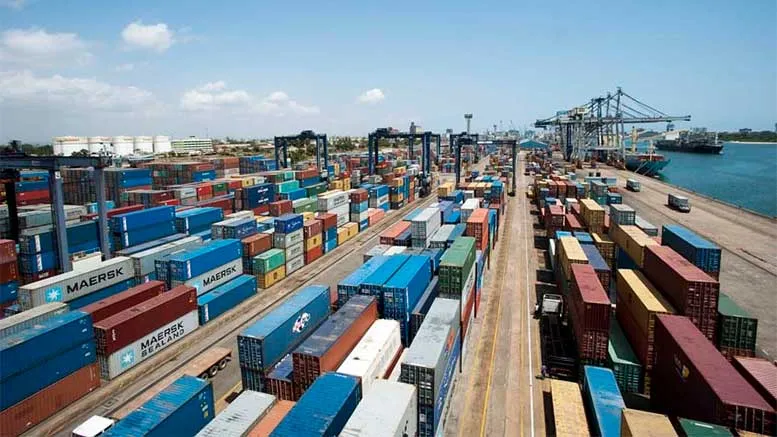
DAR ES SALAAM: TANZANIA is on the verge of a logistics breakthrough. Cargo will begin moving directly from the...
Port of Dar es Salaam via the Standard Gauge Railway (SGR) by the end of this month, a strategic shift designed to ease congestion at the country’s busiest gateway and cut logistics costs for traders.The shift marks a key step in integrating the modern rail network with the port’s operations, allowing containers to be loaded directly onto SGR freight trains and transported to inland commercial hubs without intermediate handling.
Minister for Transport Professor Makame Mbarawa said the new arrangement would eliminate the current system in which cargo must first be transported to the Pugu Inland Container Depot before being transferred onto SGR wagons.
“By the end of this month, cargo will start moving directly from the port through the SGR to inland destinations,” Prof Mbarawa said during a visit by the Parliamentary Standing Committee on Infrastructure. “This will remove the need for double handling, which has been costly and inefficient.”
Direct rail access to the SGR will enable containers to be loaded onto trains at the port and transported more efficiently to key commercial and logistics hubs in the interior of the country.
Currently, a significant portion of cargo leaving the port is transported using the Metre-Gauge Railway (MGR), which has lower capacity and efficiency compared to the SGR.
ALSO READ: Tanzania expands maize market to DRC
Prof Mbarawa also said the government is upgrading the Tanzania–Zambia Railway (TAZARA) line to strengthen trade with regional and international partners, including China. The upgrades are expected to increase train speeds from the current 32 kilometres per hour to about 80 kilometres per hour.
During the visit, members of the parliamentary committee received a progress report on the performance, construction and improvement of infrastructure at the Port of Dar es Salaam over the past nine years, from June 2017 when major reforms began to June 2026.
According to the report, the operational performance of the port over the past five years (2020/21–2024/25) has recorded significant improvements, including increases in the number of ships served, cargo handled and revenue generated.
The number of vessels handled at the port increased from 1,512 in the 2020/21 financial year to 1,990 in the 2024/25 financial year, representing an average annual growth rate of 4.9 per cent.
Similarly, total cargo handled rose from 16.269 million tonnes in 2020/21 to 27.764 million tonnes in the 2024/25 financial year, equivalent to an average annual growth rate of 14.3 per cent.
During the same period, revenue collected by the Tanzania Ports Authority (TPA) increased from 896.95bn/- in the 2020/21 financial year to 2.031tri/- in 2024/25. The total includes 1.314tri/- collected by TPA and 716.87bn/- collected by private operators, representing an average annual growth rate of 23.2 per cent.
At the same time, operational costs for TPA declined from 331.638bn/- before private sector participation to 174.764bn/- after private operators began managing some of the port’s berths.
Despite these achievements, the port still faces several challenges, including a shortage of berths to accommodate the growing number of ships, ageing infrastructure and limited space for cargo handling and storage.
To address the shortage, TPA has begun constructing new berths, including two 500-metre berths at the Malindi Wharf area, with plans underway to build 10 additional berths.
In addition, development is underway at the Kurasini (Ex-EPZA) logistics area to expand cargo handling and storage capacity. The facility will have the capacity to handle up to 700,000 containers at a time.
Parliamentary Standing Committee on Infrastructure Chairperson Mr Selemani Kakoso commended TPA for its performance over the past five years and urged the authority to explore investments beyond traditional port operations in order to broaden its revenue base.
He also stressed the need to improve service quality to sustain trade between Tanzania and neighbouring countries, particularly the Democratic Republic of Congo (DRC).
“We were recently in Congo and saw the level of cooperation between our two countries. There is a need to improve services further so that Congolese traders continue using our port,” Mr Kakoso said.
He also called for closer collaboration between TPA, the Tanzania National Roads Agency (TANROADS) and the Tanzania Railways Corporation (TRC) to enhance efficiency in the transport sector.
According to him, stronger coordination among the institutions will ensure the transport value chain operates smoothly and without bottlenecks, thereby supporting economic growth.
TPA Director General Mr Plasduce Mbossa said the new arrangement will significantly improve cargo clearance from the port.
He explained that cargo evacuation currently partly relies on the metre-gauge railway, but efficiency remains low because containers must first be transported to the Pugu Inland Container Depot before being transferred to the SGR.
“This creates double handling of cargo and increases operational costs,” Mr Mbossa said.
He added that once the new link becomes operational, cargo will be transported directly from the port to inland container depots and destinations such as Dodoma through the SGR.
Under the new system, the metre-gauge railway will continue serving routes to Kigoma and Zambia, while the SGR will handle cargo destined for Dodoma and other central regions.
No comments :
Post a Comment