


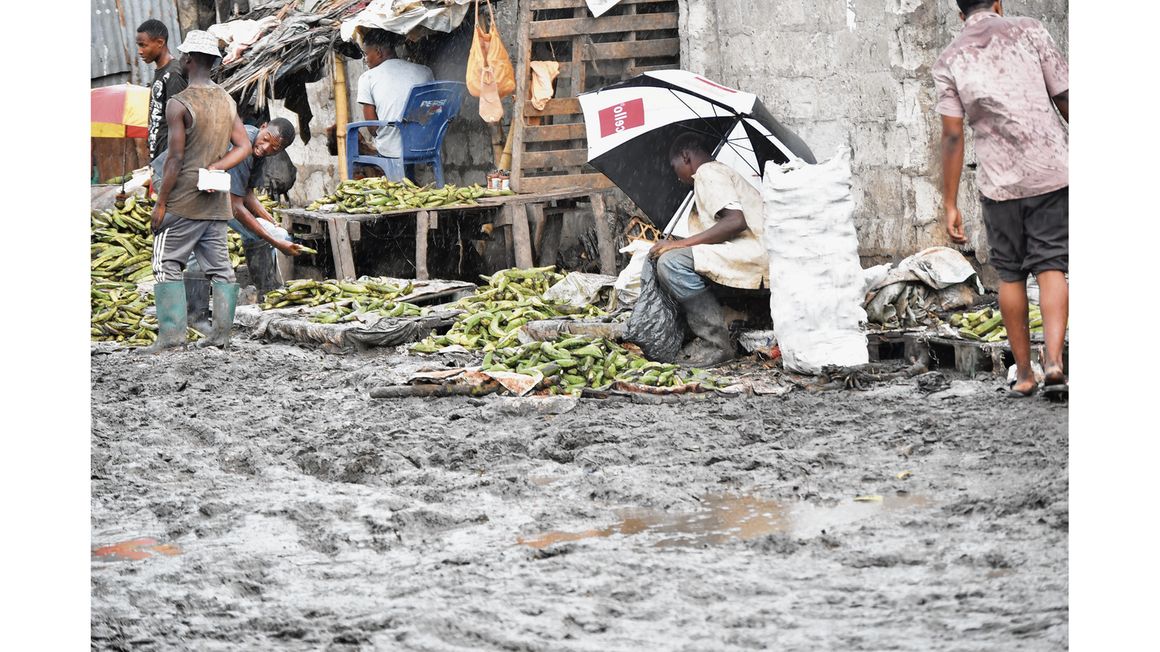
Banana traders at Mabibo market in Dar es Salaam continue with their trading duties irrespective of the dirty surrouding compounded by mud from heavy rains. PHOTO | MICHAEL MATEMANGA
By Paulina Mesomapya
Dar es Salaam. When Victoria Rafael thinks of her job, one of the things she finds annoying is the unhygienic state of the food market where she works.
The food vendor at Sterio market in Temeke is not comfortable with the unpleasant smell, mud and dirty toilets, among other things in the working area.
Markets such as Sterio, Buguruni, Ilala and Mabibo have almost similar conditions characterized by poor infrastructure, poor waste management and traders putting food items on the ground.
The markets are overpopulated, have poor ventilation and clogged ditches among the prevalent challenges.
“Infrastructure is in dire state, especially in rainy seasons. The sanitation system is also dissatisfying….we are facing so many challenges here,” said Ms Rafael who says she has no alternative for now.
“Some of us are forced to sell our commodities outside the market due to lack of space,” said another petty trader Ms Julia Malchades.
The secretary of Mabibo market Mr Swadaka Magesa said that infrastructure was a big challenge, especially during rainy season, and it is even harder this time with ongoing road construction.
He said challenges of poor infrastructure have existed since the start of the market in 2002.
“We do business all seasons but it’s very difficult during rainy seasons because we lose customers,” he noted.
Mr Magesa called upon investors to invest in the area by constructing necessary infrastructure needed for the market to run smoothly.
CAG concerns
Poor hygiene conditions at5 food markets was one of the issues raised by the Controller and Auditor General (CAG) in 2020/21 report.
The President’s Office – Regional Administration and Local Governments requires the local councils to allocate 15 percent of the market collection fees for renovations, cleanliness and development of the markets.
However, according to the report, eight councils did not comply with the requirement for four years (2016/17 – 2019/20).
Ilala was reported to have allocated only five percent while Temeke did not allocate any amount, according to the report.
Other councils which did not allocate the financing include Mbeya, Dodoma, Kigoma, Korogwe, Mbarali and Sengerema.
The report indicates that Sterio market was overpopulated by 349 percent – the highest of all markets - while that of Ilala was overpopulated by 119 percent.
The current situation of such markets exposes consumers and traders to the risk of an outbreak of epidemics such as cholera, according to the CAG report.
The report recommended that the local councils comply with the requirement to allocate financing for market development and the government hold the local councils accountable for not complying with the directives.
Efforts to get the district executive directors for Temeke, Ilala and Ubungo were unsesuccessful.
Hygiene
Speaking about proper hygiene controls in food markets, a senior nutrition researcher from the Tanzania Food and Nutrition Centre (TFNC), Mr Walbert Mgeni said people are always urged to consider hygiene when preparing food because it can be sensitive to human health.
“I urge people to take all necessary precautions to prevent themselves from catching diseases such as cholera,” he said.
No comments :
Post a Comment