


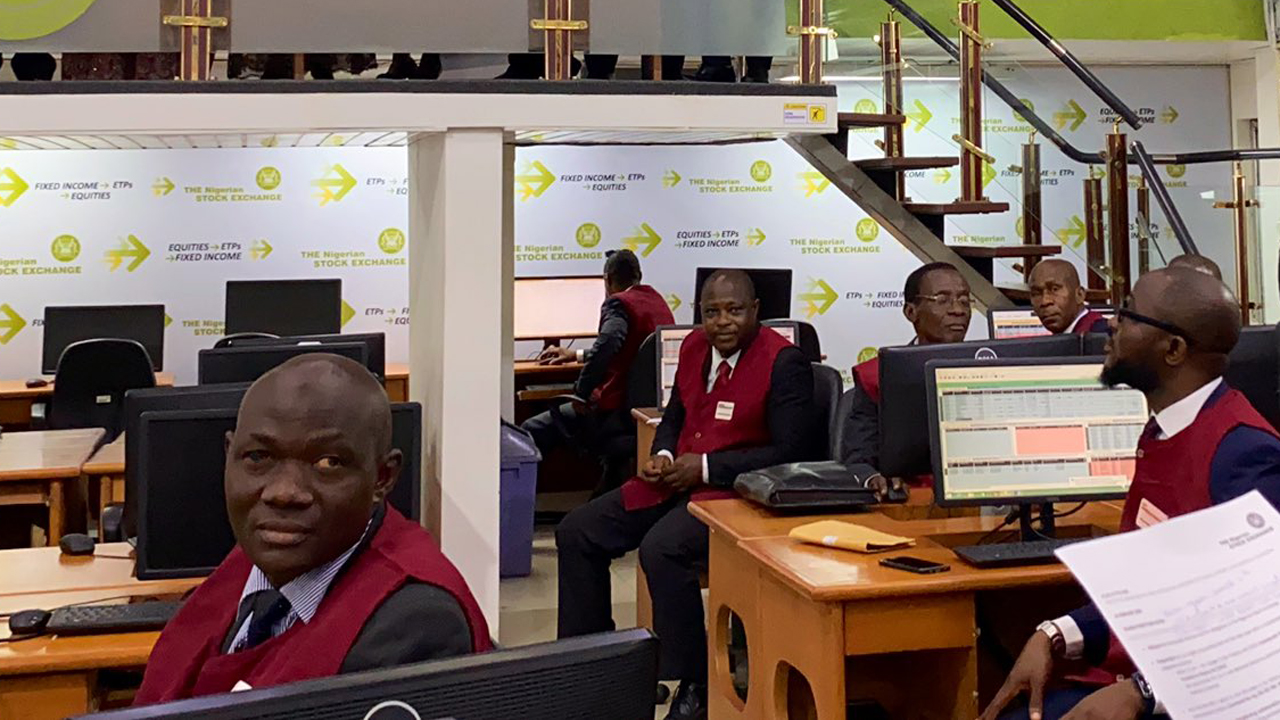
Nigerian Stock Exchange (NSE). Photo: TWITTER/OSCARNONYEAMA
By Helen Oji
Capital market experts have rated the country’s democratic regime as one that has failed to create a competitive edge for the domestic investment market.
Assessing Nigeria’s unbroken democracy since 1999, the stakeholders argued that the era delivered less than expected in terms of stimulating growth. They said the application of democratic practice has been below par.
Vice President of Highcap Securities Limited, David Adonri, said Nigeria has suffered three severe recessions within the past 22 years, noting that the economy is largely import-dependent.
Adonri said the parlous state of Nigeria’s infrastructure reflects inappropriate macroeconomic policies.
He noted that the economy is impacted negatively by social factors such as inequitable political organisations, dysfunctional institutions, insecurity and poor leadership. He said the market has found it difficult to contribute meaningfully to economic development since 2008.
According to him, only appropriate macroeconomic policies can drive the economy and impact the capital market positively. He argued that when the economic prospect is bright with growing gross domestic product (GDP).
“Economic gloom leads to a flight of financial assets to safety. In the past 22 years, the yields on debt instruments have persistently surpassed that of equities, indicating that the Nigerian economy has suffered more distress. A recent attempt to forcefully close the yield gap between equities and debt pushed inflation into a galloping mode.
“The capital market is a financing mechanism in aid of production of goods and services. It responds to fiscal policies which affect production. Multiple taxes levied on the production economy and the capital market has been a disincentive to capital formation in the economy,” he said.
A professor of capital market at the Nasarawa State University, Uche Uwaleke, affirmed that Nigeria has made remarkable progress in capital market development in the last 22, citing the recent demutualisation of the exchange and the creation of asset classes in addition to equities and bonds.
He said market infrastructure has been modernised and strengthened with the platforms for over-the-counter trading namely the NASD and FMDQ now functional, including three commodity exchanges namely the Nigeria Commodity Exchange and the Lagos Commodity and Future Exchange as the latest entrant.
However, he pointed out that the journey to making the Nigerian capital market “one of the largest, most liquid, most diversified and most sophisticated emerging markets by 2025” as envisaged in the 10-year Capital Market Master Plan seems remote despite the giant strides.
This is because he said, the market is still relatively shallow and concentrated and yet to be suitably enabled to support Nigeria’s economic priorities.
No comments :
Post a Comment