


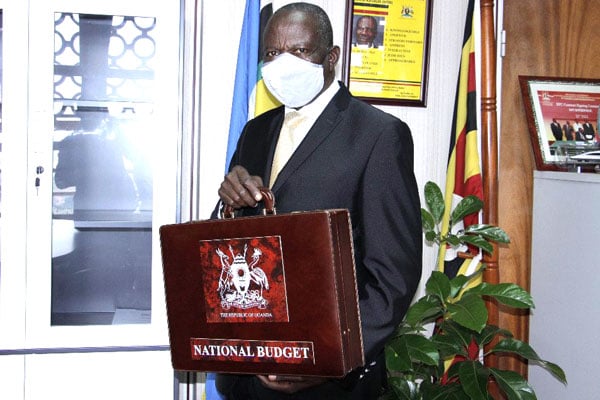
Finance minister Matia Kasaija pictured at Parliament during last year's budget reading. PHOTO/ FILE
The government has outlined key economic and social opportunities in the Budget for FY 2021/22, which it says aims at creating more jobs in the country through the Oil/Gas subsector and the
households via the Parish Development Model.The Finance minister, Maita Kasaija said during the launch of the national budget month FY 2021/22 in Kampala that the coming Financial Year presents opportunities that the government expects to spur growth in FY 2021/22.
Some of the key opportunities include: Oil and Gas investments due to three key agreements signed between Government of Uganda, Government of Tanzania as well as the Oil Companies Total and CNOOC on 11th April 2021 (Tariff & Transportation Agreement; Host Government Agreement; Shareholders’ Agreement).
“These present the following opportunities: Pave way for key projects (EACOP, Oil Refinery, Tilenga Project) worth $15 billion over the next four years; Employment opportunities (14,000 directly employed and 45,000 indirectly employed in the Sector; 105,000 to benefit from induced employment; expansion of Uganda’s GDP with expected revenues of $40 billion; and, Uganda has generated more than $1 billion even before actual production starts,” the minister said.
Mr Kasaija said from 2021 and beyond there is wide scope for Ugandan products, stressing that the wider Export Market opportunity is in line with the African Continental Free Trade Area. This aims at accelerating intra-African trade and boosting Africa’s trading position in the global market by strengthening Africa’s common voice and policy space in global trade negotiations.
The other opportunities during the FY2021/22 are Implementation of the Parish Development Model (PDM). Mr Kasaija stated that the PDM is an approach aimed at organizing and delivering public and private sector interventions for wealth creation at the parish level as the lowest economic planning unit. It accelerates implementation of Area-Based Commodity Development (ABCD) planning and it will be financed by Government of Uganda to a tune of Shs200 billion, in the first year of implementation.
Regarding the budget strategy for FY 2020/21, Mr Kasaija said the strategy focuses on six broad and interlinked agenda; maintenance of Security, peace and good governance through modernization of the security infrastructure, improving the welfare of security personnel, enforcing law and order, compensation for war-affected persons and overall improvement in the efficiency of the state machinery.
Accelerating the pace of industrialization, research and innovation thus enhancing value addition to our agricultural and mineral commodities; enhancing the capacity to deal with both the demand and supply side challenges anchored on import substitution and export promotion
Others includes; human capital development by investing in community health, education and water; Strengthening the private sector by improving enterprise competitiveness with emphasis on improved physical infrastructure like roads, energy, ICT and industrial parks.
The target is to reduce the cost of doing business through increased efficiency and effectiveness of public sector investments; and championing inclusive growth through implementation of the Parish Development Model, which will enable Households still in subsistence agriculture to join the money economy.
“Arising out of this Budget Strategy for FY 2021/22, we are projecting a growth rate of 4.3 percent, up from the projection of 3.1 percent for this Financial Year 2020/2021. This is based on the assumption that the negative consequences of the pandemic will subside with Covid-19 vaccinations and other clinical trials,” he said.
Mr Kasaija explained that over the medium term, growth is projected to reach potential levels of between 6.0 percent to 9.0 percent, supported mainly by enhanced private sector activity due to increased aggregate demand post Covid-19; accelerated returns from public infrastructure investments; continued improvement in the Agriculture Sector and increased activities in the oil and gas sector.
In light of the growth strategy above, the budget will prioritize the following areas: Infrastructure development; skilling; Security and wealth creation.
The priority allocations in the budget for FY 2021/22 (excluding debt) for major service delivery sectors are therefore as follows: Human Capital Development (Health, Education, etc)- Shs7.766 trillion; Governance and Security Shs6.968 trillion, Integrated Transport Infrastructure and Services Shs5.070 trillion; Agro-Industrialization Shs1.688 trillion.
No comments :
Post a Comment