


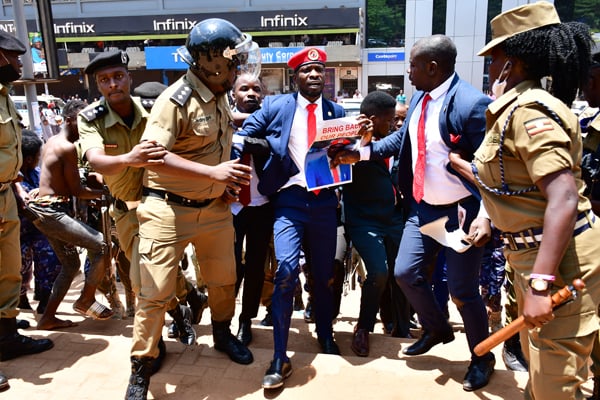
NUP president Robert Kyagulanyi, alias Bobi Wine, is arrested on March 15 in Kampala during a protest over his missing supporters. PHOTO/ ABUBAKER LUBOWA
Article 29 of the Constitution provides for peaceful protests for
expression of dissatisfaction. But history tells us that most of such
political activities turn bloody, often fatal for both participants and
bystanders.
The events of November 18-19, 2020, that left at least 54 Ugandans dead are the latest and the gravest of such occurrences.
A
call by former National Unity Platform (NUP) presidential candidate
Robert Kyagulanyi for such protests three weeks ago has been met with
low enthusiasm.
On March 15, Mr Kyagulanyi attempted to march through
the streets of Kampala in protest of what he termed as illegal
detention of NUP supporters.
Standing on sidelines
Unlike
in the pre and during the campaign period when his appearance in public
attracted considerable numbers, Mr Kyagulanyi was accompanied by only a
handful of people, most of these leaders in his party. People stood on
the sidelines and looked on as police dragged the legislator away.
“They’ve
oppressed us, exploited us and turned us into slaves in our own
country. The women, whose sons are missing, the Ugandans who voted and
your results were short-changed, come out and peacefully demonstrate
against that impunity,” Mr Kyagulanyi said a week before his arrest.
Even
with emphasis on discipline, security agencies assured Ugandans they
would deal with those planning to disrupt the country under the cover of
peaceful demonstrations.
A fortnight later, the call for protests is almost forgotten and Mr Kyagulanyi has travelled out of the country.
The
most sustained post-election protests happened in 2011. After another
disputed election, the Opposition, led by former Forum for Democratic
(FDC) presidential flagbearer Kizza Besigye, organised the walk-to-work
protests, in which Ugandans were called to abandon motorised transport
and walk to their workplaces as a way of protesting against increasing
costs of fuel and other commodities.
At least nine people were killed
as the months-long protests raged, and Dr Besigye was injured and
airlifted to Nairobi, Kenya, after a debilitating attack by security
personnel during the protests.
With security agencies on alert,
and the horrors of extrajudicial killings, arrests and kidnappings
widespread over the recent weeks, experts say Mr Kyagulanyi’s call was
ill-timed.
During the election period, Mr Museveni deployed a section of war-hardened military personnel to oversee security in Kampala.
Findings
from a pre-election study, Citizens views on election campaigns, voting
and post-election environment conducted by Afrobarometer, a public
opinions project that covers most of Africa, show that 76 per cent of
Ugandans were wary of violence at the declaration of election results
due to refusal by the losing side to accept the announced results.
Going to the polls, according to the same poll, 70 per cent of the
respondents expressed fear of becoming a victim of political
intimidation or violence, an increase from 63 per cent in 2015. This
consequently caused more than 78 per cent of Ugandans to urge the losing
side to accept the result and move on regardless of whatever misgivings
they may have of it.
Fear, according to the survey, was highest in
the central region – at 84 per cent in urban dwellers between 18 and 30
years. The study was conducted a month after 54 Ugandans were killed in
protests that broke out following the arrest of then presidential
candidate Kyagulanyi in mid-November last year.
An investigation
by this newspaper in February revealed that more than half of those
killed in the November protests were below 30 years of age.
The
killings happened in the towns of Kampala, Mukono, Luweero, Masaka City,
Jinja City, Kyotera and Rakai districts, which, except for Jinja, lie
in the central region.
Mr Museveni polled six million of the votes
cast, according to the Electoral Commission (EC), while his main
challenger, Mr Kyagulanyi, polled 3.6 million votes. EC’s official data
shows NRM got 35 per cent in the central region while Mr Kyagulanyi’s
NUP cruised with 62.01 per cent.
President Museveni, in a
televised address, pointed the finger at the demonstrators, whom he has
often referred to as “terrorists”.
“Unfortunately, 54 people died in
this confusion. Thirty two victims were rioters, some were hit by
stray-bullets and two victims were knocked by vehicles… It is criminal
to attack security forces by throwing stonet
the attackers if they fail to respond to the firing in the air… We
should not have a country of rioters,” he said.
The protests also left 1,014 suspects arrested. Majority have since been released on bail.
According
to the Afrobarometer report, however, four in 10 of Ugandans would
support the losing side to engage in peaceful demonstrations.
Ms
Charity Ahimbisibwe, the head of the elections observer group CCEDU,
however, says Mr Kyagulanyi’s timing of the protests is off due to the
chilling effect of the November deaths.
“During the election, many
people lost their lives and many people have so many questions as to why
their people had to die for an election. Families are still grieving.
There are so many unanswered questions, and that pain is not going to go
away anytime soon,” she says.
“Calling for protests is not the
way forward because they will be taken advantage of because of the pain.
The best move for now is dialogue and comprehensive reform. If
Kyagulanyi calls for constitutional review, he would get more support
than standing on the streets. Ugandans are afraid of being killed and
disappearing.”
In the post-election era, the country has been gripped
by harrowing tales of persons going missing. Government admitted to
having a number under detention, while the NUP claims that many are
unaccounted for.
Kampala Deputy Lord Mayor Doreen Nyanjura has led
and participated in numerous demonstrations under FDC. She says the
theme of protests is important in rallying participants.
“It is
work in progress, sometimes protestors will turn up depending on the
theme and the time. In 2011, we did not rally Ugandans to fight for
their victory, but rather protested the inflated prices. After the 2016
elections, we rallied Ugandans to stay home and very few obliged. It did
not appeal to them directly,” Ms Nyanjura says.
Mr Joel Ssenyonyi,
the NUP spokesperson, says the party is wary of the dangers that come
with protests, but adds that they are between a rock and a hard place.
He says there has been some response and he believes it will build up.
“The
idea is to use legal means to express our dissatisfaction to take
action as citizens because what else do we have? That is the power that
we have,” Mr Ssenyonyi.
The report by Afrobarometer placed the
leaders or supporters of Opposition parties at the top of the list of
those expected to cause violence at 41 per cent, followed by the ruling
party at 29 per cent.
“People say we are causing the people to be
killed but who is killing these people? Is it Kyagulanyi or the brutal
regime? For us we operate within the legal regime. We continue with the
protests, asking people to raise their voice,” Mr Ssenyonyi says.
The business community, however, is usually also aggrieved by protests that bring businesses to a standstill.
Following
Mr Kyagulanyi’s call, Kampala Capital City Traders Association in a
statement cautioned Kyagulanyi against rallying his supporters to
protest because of the damage previous protests have dealt businesses.
“Protests in Kampala have always been violent and we innocent traders are always the primary targets of the protestors who always loot our property and disrupt our businesses for days. It is this regard that we demand the leadership of NUP to reconsider their plan and look for other means of settling their political issues other than opting to destroy our livelihood,” they appealed.
No comments :
Post a Comment