


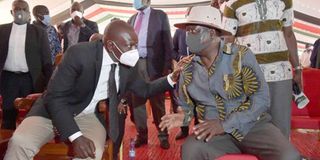
Deputy President William Ruto and ODM party leader Raila Odinga during the funeral service for former Matungu MP James Murunga at Makunda Primary School.

What you need to know:
Last week, I railed spiritedly at the current political turmoil, brinksmanship and intolerance which have pitted two leaders, one of whom has settled on a solution that may lead this country into great danger if not addressed properly, while the other is set on constitutional change whose overall ramifications may equally be perilous unless it garners more national support.
What got me going was the kind of intolerance gathering pace whenever the two and their attack dogs strive to sell their story to ordinary folk, growling at each other all the while. What I forgot to say was that as all this is happening, our economy is inexorably tanking, and we are in the grip of an unforgiving virus that is partly responsible for the recession.
But to these folk, this is a small matter that can be sorted out by everyone supporting the Building Bridges Initiative or pushing wheelbarrows uphill. Problem is that those ordinary people who are being fought over do not have an inkling of what is going on, and too many are just struggling to survive long enough to sell their votes for a pittance next year. The real hustlers live on hope alone.
Yet when told to pelt their brothers with stones they do so with great gusto, oblivious of the fact that they are being misused. Could there be a more convincing reason to despair at our collective naivety? What the BBI means is still unclear to many Kenyans. It is said to be long on specifics but short on a coherent catchy message. At the same time, what the “Hustler Nation” stands for remains short on specifics but with a message that boasts tremendous propaganda value.
Let’s get this straight: to be wealthy is not a crime; permanent destitution is. If nine out of 10 members of the human race dream of leading a comfortable life, they can’t all be wrong. However, only a relatively few ever make it in life and while some among them do so because of their industry, smart choices or real talent, a vast number are crooks who reap where they never sowed, a significant proportion of whom appear to live in Kenya. However, our corruption and its deleterious effects on its victims is a subject for another day.
Widespread poverty
What is more apropos here is that ostentatious opulence in the midst of widespread poverty is an obscenity and a crime against humanity, which is to say that it should not be tolerated for too long lest things blow up. That is where responsible governments come in — timely intervention to forestall such an occurrence, which in sociopolitical parlance is a revolution.
Those familiar with the historical accounts of such upheavals will concur that conditions in this country are becoming ripe for a cataclysm and those politicking without offering concrete solutions are doing a disservice to this country.
Political economists and philosophers have always agonised over how to alleviate poverty among the masses without killing the entrepreneurial spirit. The reason why socialism has always failed is that governments that tried to impose egalitarianism without taking into consideration the necessity of individual ownership of wealth always foundered on the rock of pragmatism.
You cannot produce goods and services efficiently unless you have a stake in the outcome. No government can be expected to better the lives of its subjects through handouts in perpetuity.
However, in some instances, it must intervene. Not everyone is capable of grabbing or even recognising opportunity when it knocks on the door. Some individuals and communities are more vulnerable than others in every way. For instance, a 70-year-old widow should not starve just because she cannot hustle and fend for herself. On this score the government should be commended. The stipends given to the aged are a good example of what a social security net should be, if only the aged did not have to line up all day outside banks for the meagre cash.
Social security
In all other parameters of social security it has failed. Those people who lost their jobs en masse after the Covid-19 outbreak should have, in happier circumstances, been financially supported until other jobs were found. But, even the wealthiest countries find it a challenge to subsidise livelihoods during natural calamities.
Ideally, government should take care of the public healthcare and education systems. Our much-heralded free education programme has never been anything like that, while healthcare was dumped on governors, some of whom are clueless.
All these services constitute social welfare, the third viable ideology that bridges socialism and crude man-eat-man capitalism. That is where we in Kenya should be heading. The best way to narrow the poverty gap is to administer an astute mixture of capitalism and socialism.
There is, of course, a stiff political price to pay because to underwrite these interventions, the government must impose higher taxes. Kenya does not have the means to become a welfare state, but unbridled capitalism cannot be allowed to run riot for much longer.
Mr Ngwiri is a consultant editor; andrewngwiri@gmail.com
No comments :
Post a Comment