


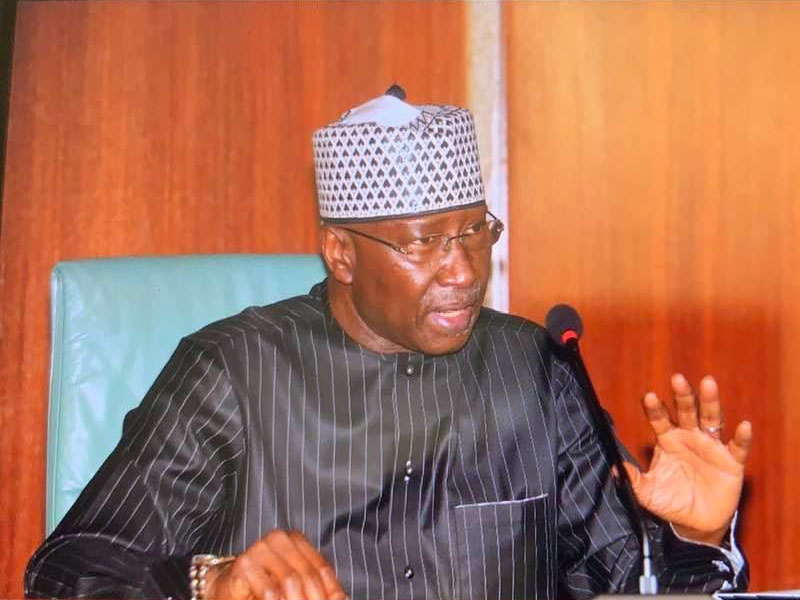
The Secretary to the Government
of the Federation, Mr. Boss Mustapha, in this interview, speaks on
wide-ranging issues, stretching from fiscal policy decisions and actions
of the federal government to varied government’s intervention
programmes as the nation battles to combat the dreaded COVID-19
pandemic. Excerpts:
With the attendant negative
effect of COVID-19 on crude oil prices, globally, Nigeria’s major
foreign exchange earner has taken a bad hit. How has the Buhari
administration bridged the gap in funding of the economy?
There is no doubt that COVID-19 pandemic
has adversely impacted on the global economy. The virus has affected
every aspect of human existence. Industrialized nations of the world are
not spared either. Most countries of the world have had to review their
economic growth rates. Stimulus packages have been introduced by some
other countries to prevent the total collapse of their economies.
Nigeria, like many other nations, whose major source of revenue is crude
oil has had to contend with the sharp decline in the global crude oil
price. The country’s GDP in the first quarter of 2020 was 1.87 per cent
compared to 2.27 per cent in 2019 due to the decline in global economic
activities occasioned by the COVID-19 pandemic. To bridge the gap in
funding the economy, Mr. President constituted the Economic
Sustainability Committee chaired by the Vice President. The Committee
has submitted its report. Government has also put in place measures to
stabilize the economy. The measures put in place are enunciated in Mr.
President’s Democracy Day nationwide address on June 12, 2020.
The security and monitoring of
the nation’s oil pipelines is of paramount concern given the importance
of crude oil to our national life. What effort is the administration
making through the Presidential Amnesty office in ensuring that the
Niger Delta remains peaceful?
Niger Delta, like every other region of
the country, is so important and unique to the economic wellbeing of
Nigeria. The administration of President Muhammadu Buhari has since its
inception been engaging with leaders and youths of the Niger Delta
Region and this effort has yielded remarkable results. With continuous
dialogue, peace has returned to the region. We are constantly reminded
that peace is a panacea for both economic and social development in the
region. The Presidential Amnesty Office has continued to deliver on its
mandate by empowering Niger Delta Youths through scholarships and
provision of infrastructure and social amenities.
In addition to the role of the Amnesty
Office, Government is working hard to reposition the Niger Delta
Development Commission to be able to wake up to its statutory
responsibility of delivering developmental projects to every community
in the region. All these efforts and engagements of government with
leaders and youths of the Niger Delta region have resulted in peace and
security, making it easier for the law enforcement agents to monitor
pipelines in the region.
The North-East Development
Commission is a novel project by this administration. What is the
progress report as Nigerians are yet to feel the impact?
The North-East Development Commission (NEDC) is the focal organisation charged with the responsibility to assess, coordinate, harmonize and report on all intervention programmess, and initiatives by the Federal Government or any of its Ministries, Departments and Agencies (MDAs), States; and other development partners and for the implementation of all programmes and initiatives for the North- East states of Adamawa, Bauchi, Borno, Gombe, Taraba and Yobe. Since the Management Board was inaugurated in 2019, it has embarked on a number of programmes which are categorized under humanitarian, co-ordination, early recovery, long term development as well as North- East recovery and stability. The commission has been supporting in the fight against COVID-19 in the North East geopolitical zone. The NEDC has also provided medical outreach in Maiduguri. Over 4,000 indigenes have benefitted from the programme. Relief materials are also being distributed from time to time while several communities have benefitted from the provision of social amenities with the objective of improving quality of life among the rural communities. The commission, no doubt, has been working so hard to ensure that the zone is completely rebuilt and developed after years of insurgency.
The North-East Development Commission (NEDC) is the focal organisation charged with the responsibility to assess, coordinate, harmonize and report on all intervention programmess, and initiatives by the Federal Government or any of its Ministries, Departments and Agencies (MDAs), States; and other development partners and for the implementation of all programmes and initiatives for the North- East states of Adamawa, Bauchi, Borno, Gombe, Taraba and Yobe. Since the Management Board was inaugurated in 2019, it has embarked on a number of programmes which are categorized under humanitarian, co-ordination, early recovery, long term development as well as North- East recovery and stability. The commission has been supporting in the fight against COVID-19 in the North East geopolitical zone. The NEDC has also provided medical outreach in Maiduguri. Over 4,000 indigenes have benefitted from the programme. Relief materials are also being distributed from time to time while several communities have benefitted from the provision of social amenities with the objective of improving quality of life among the rural communities. The commission, no doubt, has been working so hard to ensure that the zone is completely rebuilt and developed after years of insurgency.
The fight against corruption is
one of the major cardinal projects of the Buhari Administration. Kindly
give us a scorecard of the administration’s effort to stamp out graft
and what in your estimation are the major obstacles?
In the area of fighting corruption, the
Buhari administration has shown a consistent determination to fight the
cankerworm decisively. Since the president assumed office in 2015, so
much has been done in terms of recovery and prosecution of offenders. In
the second term of the administration, the focus is to strengthen all
anti-graft institutions; putting in place mechanism that will help stop
corruption from taking place at all because it comes with a lot of
expenses which I know requires a lot of paradigm shifts. Fighting
corruption also entails building structures and evolving policies to
make corruption unattractive. I believe that we need to create safety
nets for the people in the workplace as a disincentive for corrupt
tendencies. Going forward, we should strengthen the institutions and
build capacities for them; make sure too that we create safety nets
around the whole place so that people can have a bit of comfort. The
federal government is quite conscious of the need to deliberately evolve
and implement policies and programmes to promote accountability and
transparency through the Open Government Partnership. Through the
transparency portal on financial transactions we have strengthened
auditing and accountability mechanisms so as to ensure that rules and
regulations are followed strictly, while minimising fraud and theft of
government funds.
The report recently submitted by
the committee headed by the Vice President on post-COVID-19 effect is
grim, as an estimated 39.4 million jobs would be lost this year. What
safety nets is the administration putting in place to cushion the
effect?
The pandemic has provided a unique
opportunity to x-ray the state of our healthcare sector, which is in
dire need of reforms and funding. The weaknesses in our health system
became more glaring as we see how more established health systems in
Europe and America have buckled under pressure. To directly address the
economic challenges of Covid-19, President Muhammadu Buhari approved a
Fiscal Stimulus Package as part of an Integrated Policy Framework to
ensure that Nigeria’s healthcare system, fiscal position and economy are
sufficiently supported to weather these shocks. We have received
assurances of support from our partners at the World Bank. We are
continuing our engagements with the World Bank, the African Development
Bank, and the Islamic Development Bank to access concessional funding to
support the implementation of the 2020 Budget. We have also applied for
funding from the International Monetary Fund’s COVID-19 Rapid Credit
Facility to draw from our existing holdings with the World Bank
Group/International Monetary Fund. This loan will attract no
conditionalities.
However, it is essential to clarify that
Nigeria does not intend to negotiate or enter into a formal programme
with the International Monetary Fund at this time or in the foreseeable
future. The federal government has provided N102.5 billion in resources
to be available for direct intervention in the healthcare sector. Of
this sum, the government has already made available N6.5 billion to the
NCDC for critical expenditure. The federal government remains committed
to supporting the states in these difficult times in battling with the
COVID-19 pandemic. The federal government is committed to the
augmentation of the states’ FAAC allocations and moratorium on states’
debts. Based on the financial assumptions underpinning of the 2020
Appropriation Act, the Federal Government projected the monthly
Federation Account Allocation Committee disbursements to the Federal and
State Governments at N888.5 billion. However, due to the significant
drop in international oil prices, FAAC monthly disbursements have
declined in recent months to N716.3 billion in January and N647.4
billion in February 2020. Our experience shows that monthly FAAC
receipts must average at least N650billion for the Federal and State
Governments to meet their current obligations.
We must prepare our minds that monthly
receipts may decline to below N400 billion, over the next three to six
months. To address these emerging fiscal risks, Mr. President has
approved the withdrawal of US$150million from the Nigeria Sovereign
Investment Authority Stabilisation Fund to support the June 2020 FAAC
disbursement. The federal government has created the Stabilisation Fund
for such emergencies and Government will utilise it for this purpose.
Government is exploring other options to augment FAAC disbursements for
the 2020 fiscal year. The President has approved that the Federal
Ministry of Finance, Budget and National Planning should engage with the
CBN to agree on a Debt and Interest Moratorium for States on Federal
Government and CBN-funded loans. The moratorium will create fiscal space
for the States, given the projected shortfalls in FAAC allocations.
Accordingly, once monthly average FAAC receipts fall below a specific
threshold, relevant bodies will suspend interest and capital payments by
States until monthly average FAAC receipts exceed the threshold.
The moratorium intervention is vital to
create fiscal space for the states, as they deal with the health and
economic impact of the crisis. The federal government will also
encourage states to explore similar arrangements for their outstanding
debts to commercial banks. The Finance Act 2020 provided significant tax
relief for micro, small and medium-sized enterprises. The Finance Act
has also expanded the VAT Exemption List for essential food, medical
supplies and other basic items that are critical in the effort to
address the COVID-19 pandemic. Government has also granted a two-month
waiver on licence fees for broadcast organisations.
The 2020 Appropriation Act rested on certain fiscal assumptions that certain economic realities have compelled the government to revisit given the emerging economic realities.
The 2020 Appropriation Act rested on certain fiscal assumptions that certain economic realities have compelled the government to revisit given the emerging economic realities.
How would you assess the
leadership of the national oil company under Mr. Mele Kyari, given the
fact you have worked with him closely during this Covid-19 intervention?
Mr. Mele Kyari, the Group Managing
Director of the Nigerian National Petroleum Corporation, has brought
dynamism and pragmatism to the management of the organisation. NNPC
under his leadership has contributed immensely to the national response
to COVID-19 by mobilizing private investors to contribute and support
the efforts of the Presidential Task Force on COVID-19. As a result of
his efforts and that of the Governor of the Central Bank of Nigeria,
substantial donations both in cash and kind have been received by the
Federal Government. Although the coronavirus pandemic happened on us
without warning, I think as a nation we have not done badly in our
national response.
Government and the private sector
players alike have been quite responsive in the effort to combat the
disease and defeat the pandemic. The NNPC has lived up to its status as a
corporate giant, rallying companies in the oil and gas sector to raise
funds and provide the critical equipment and facilities through their
international contacts. We cannot but commend Mele Kyari and his team
for their patriotic spirit in raising funds running to billions of Naira
and applying the same judiciously. By and large, the NNPC has acquitted
itself well in discharging its corporate social responsibility
Culled from thewhistler.ng
Culled from thewhistler.ng
No comments :
Post a Comment