


 By Faustine Kapama
Zanzibar — THE
Attorney General (AG), Prof Adelardus Kilangi has voiced misgivings
against the judgment that the government should remove from its penal
laws, the death sentence against murder
convicts.
He told the 'Daily
News on Saturday' over the phone that Tanzania is governed by laws, the
Constitution of the United Republic of Tanzania taking the lead.
"In our legal
hierarchy, the Constitution is the supreme and controlling law. We are
bound by our Constitution," the AG Prof Kilangi pointed out that what
follows is the law enacted by the parliament and then case laws, whereas
international laws come later. "Any decision that is given must be in
conformity with our laws," he said.
The AG reserved
more comments on the matter, saying he would provide a comprehensive
reaction on nthe decision of the continental court after being supplied
with the typed copy of the judgment in question.
Composed of ten
justices, led by President Sylvain Oré, the Court on Thursday directed
the government of Tanzania, as respondent state, to take necessary
measures within one year to repeal the provision of Section 197 of the
Penal Code, which provides such capital punishment.
"This court orders
the respondent state to take necessary measures within one year from the
date of notification of this judgment to remove the mandatory nature of
imposition of the death sentence as it removes the discretion of the
judicial officer," they declared.
The justices gave
the orders when determining an application lodged by three convicts of
murder, Ally Rajab, Angaja Kazeni, alias Oria, Geoffrey Stanley, alias
Babu, Emmanuel Michael, alias Atuu, and Julius Michael, who are citizens
of the United Republic of Tanzania.
They found that
Section 197 of the Penal Code does not compel the convicted person to
provide mitigating evidence and the trial court is left with no other
option than to impose the death sentence to the convicted person.
"The Court found
that mandatory imposition of the death penalty is automatic and its
imposition does not permit consideration of mitigating factors; applies
to accused persons blindly; takes away the discretion of judicial
officer and does not observe proportionality between the facts and the
penalty," they said.
In their landmark
judgment, the justices also ordered the respondent to publish in the
websites of the Judiciary and the Ministry of Justice and Constitutional
Affairs, the judgment in question, which should remain accessible at
least for one year from the date of notification of its existence.
The Court, during
the closure of the four-week sitting of the 55th Ordinary Session held
here, further directed the government to provide a report in six months'
time, on the implementation of the judgment.
According to the
justices, the mandatory imposition of the death sentence does not uphold
fairness and due process as guaranteed under Article 7(1) of the
Charter.
They noted that
lack of mention of the death penalty in Article 4 of the Charter and the
strongly worded provision for the right to life therein are to the
effect that the failure of the mandatory death sentence to pass the test
of fairness renders the penalty contrary to the right to life under
Article 4 of the Charter.
"The mandatory
death sentence for murder in Section 197 of the Tanzanian Penal Code
constitutes an arbitrary deprivation of the right to life and therefore
that the Respondent State has violated Article 4 of the Charter," the
justices ruled.
The Court also
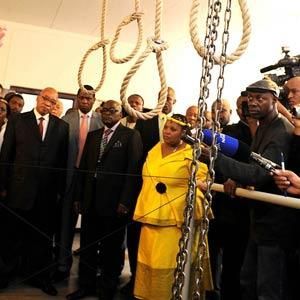
found that methods of implementing the death penalty amount to torture,
inhuman and degrading treatment, given the suffering inherent thereto.
They pointed out
that due to the arbitrary nature of the mandatory imposition of the
death penalty; Its execution by hanging is consequently and inevitably
in violation of the right to dignity in respect of the prohibition of
torture and inhuman and degrading treatment.
"The Court
therefore found that the Respondent State has violated Article 5 of the
Charter," the justices declared, adding that having enacted its Penal
Code or amended it subsequent to the entry into force of the Charter,
Tanzania was under the duty to bring the law in line with the Charter
upon ratification.
They, however,
rejected the request by the applicants for the court to be released from
prison, as the violations of their rights as per Article 4 and 5 of the
Charter had nothing to do with their applicability of their
convictions.
Instead, the justices ordered for fresh sentencing hearing after the law amendments.
The justices noted
that the applicants' sentencing is affected only to the extent of the
mandatory nature of the penalty and, thus, directed the Respondent State
to set aside the sentence and replace it with any other order that it
will deem appropriate within its domestic processes.
The applicants were
arrested in September 2006 in connection with the murder of Jamal
Abdallah. On February 3, 2009, they were charged with the offence of
murder at the High Court of Tanzania at Moshi.
After a full trial,
they were found guilty, convicted and sentenced to death by hanging.
The judgment was delivered on November 25, 2011.
The applicants
appealed to the Court of Appeal which is the apex court in the Tanzanian
judicial system. On March 25, 2013, the Court of Appeal upheld the
Applicants' convictions and confirmed the death sentences.
No comments :
Post a Comment