


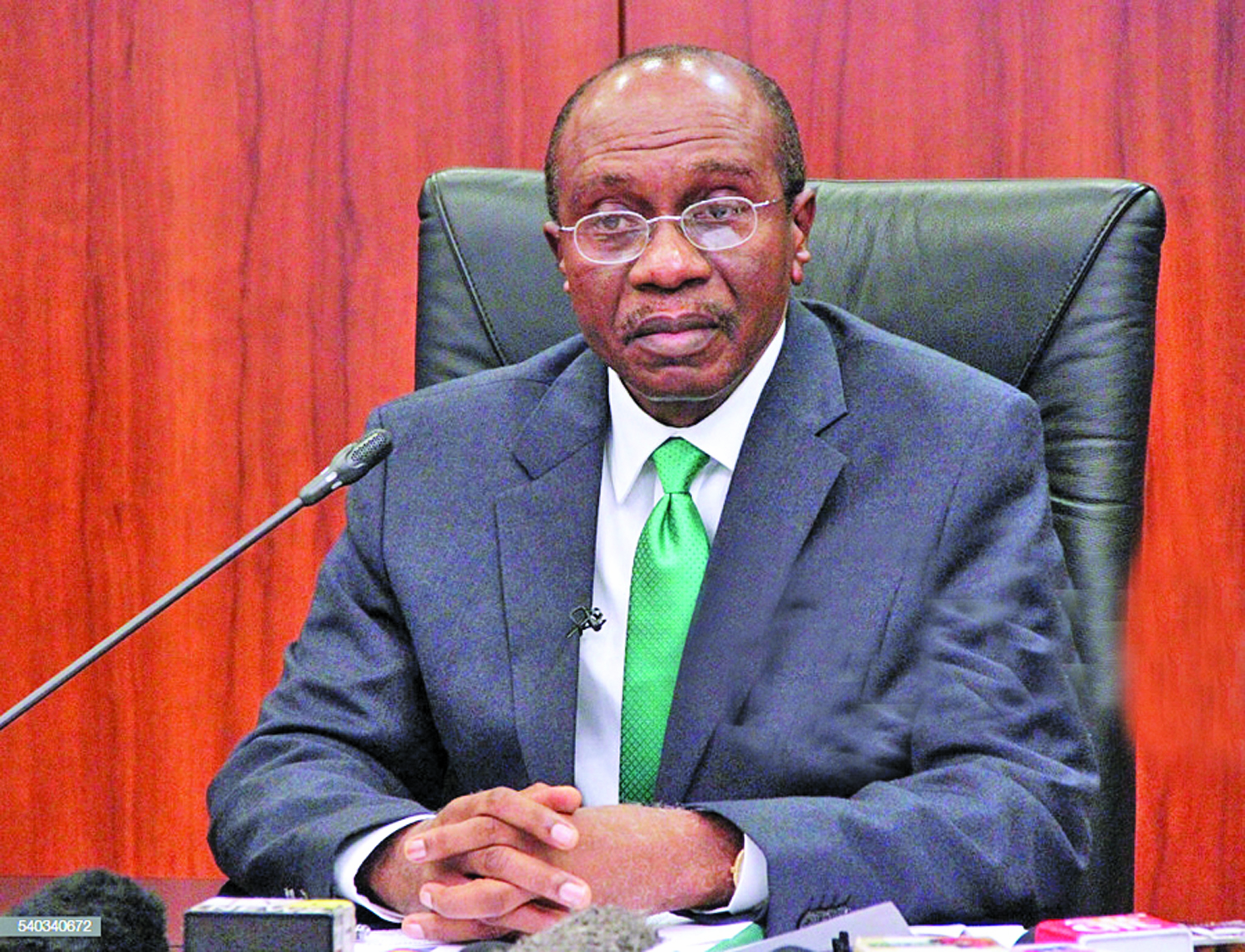
 Godwin Emefiele
Obinna Chima
The decision by the Central Bank of
Nigeria (CBN) Governor, Mr. Godwin Emefiele, to completely prohibit
individuals and local firms from investing in both its
primary and
secondary Open Market Operations (OMO) auctions about two months ago is
having a positive impact on deposit and lending rates, THISDAY findings
have shown.
THISDAY learnt that following the CBN
circular that was announced in October, there has been noticeable
decline in lending rates of commercial banks by at about six per cent.
Similarly, deposit rates paid by banks
to customers have also dropped drastically to between two to three per
cent, while interest rate has nosedived from as high as 18% to around
11%.
In fact, THISDAY learnt that awash with
liquidity as a result of the CBN’s OMO exclusion policy, banks became
afraid that accepting priced deposits would result in the decline of
their loan-to-deposit ratio and subsequently resorted to refusing large
fixed deposits from their customers.
The banks are jostling to meet with the
65 per cent minimum loan-deposit-lending ratio that they were directed
to comply with by the end of this month.
It was gathered that the exclusion of
the pension fund administrators from OMO and the CBN LDR policies have
created intense competition by banks for loans, which has resulted in
the observed drop in lending and deposit rates.
Additionally, recent surveys conducted
showed that banks are offering as low as two per cent to customers on
fixed/ term deposit. This refusal has also helped in stimulating
activities in the equities recently.
A bank chief executive officer, who pleaded to remain anonymous, confirmed this in a chat with THISDAY last night.
“The average interest rate on deposits
is presently about four per cent. For lending, some of the large
corporates today are borrowing at about 12 per cent, depending on the
bank.
“For medium term corporate borrowers, it is about 15 to 17 per cent. Indeed, last week, the Dangote Group did Commercial Paper where it raised N45 billion at seven per cent,” the bank CEO added.
“For medium term corporate borrowers, it is about 15 to 17 per cent. Indeed, last week, the Dangote Group did Commercial Paper where it raised N45 billion at seven per cent,” the bank CEO added.
Some market analysts have hailed the
CBN’s unconventional monetary policy approach given that whereas the
monetary policy rate (MPR) has remained unchanged at 13.5 per cent, the
discovery by the CBN of certain structural inefficiencies in the
interest rate structure where OMO, which is monetary policy tool meant
for only the banks and the foreign portfolio investors, had been
infiltrated by the Pension Fund Administrators (PFAs).
The co-founder of Cardinal Stone
Partners Limited, Mr. Mohammed Garuba, had pointed out that until the
CBN decided to restrict its OMO auctions, it was only in Nigeria that
private sector and individuals were allowed to invest in the securities.
He had explained that OMO auction was supposed to be strictly between the central bank and banks.
“It is a liquidity management tool. PFAs and the rest were never
supposed to invest in OMO. For normal Nigerian Treasury Bills (NTBs), it
is open to everybody, you fill your forms and go for auction. But OMO
is 100 per cent at the central bank’s discretion. The central bank can
decide to issue it anytime or any day they like. That is how it is
everywhere in the world apart from Nigeria,” Garuba explained.
The Nigerian stock market had rebounded
in November, primarily as a result of the CBN policy that restricted
individuals and local firms from investing in its OMO auctions.
Contrary to a decline of 4.9 per cent
suffered by the Nigerian Stock Exchange’s (NSE) All-Share Index (ASI) in
October, the market benchmark gauge had appreciated 2.4 per cent in
November. Similarly, the market, which dipped by N642 billion in
October, had gained a total of N204 billion in November.
While the NSE ASI had appreciated from 26,355.35 to 27,002.15, market
capitalisation had risen from N12.829 trillion to N13.033 trillion.
In the same vein, A report by Cordros
Securities Limited, at the weekend showed that overnight (OVN) rate
undulated last week before settling lower by 0.28 percentage points at
2.8 per cent.
The report showed that this week, treasury bills maturities worth a
combined N73.30 billion – OMO (N51.30 billion) and PMA maturities
(N22.00 billion) and Federal Government Savings bonds coupons (N13.33
million) – from the 11.418% JUN-2021 and 12.418% JUN-2022 instruments –
were expected during the week.
In combination with the already substantial system liquidity level,
we expect the rate to remain moderate during the coming week.
“In our view, the restrictions on trading in OMO will continue to drive
volumes in the treasury bills market. Consequently, we expect the
average yield in the market to settle in the single-digit territory by
2019 ending,” the Lagos-based firm added.
No comments :
Post a Comment