


Goddy Egene
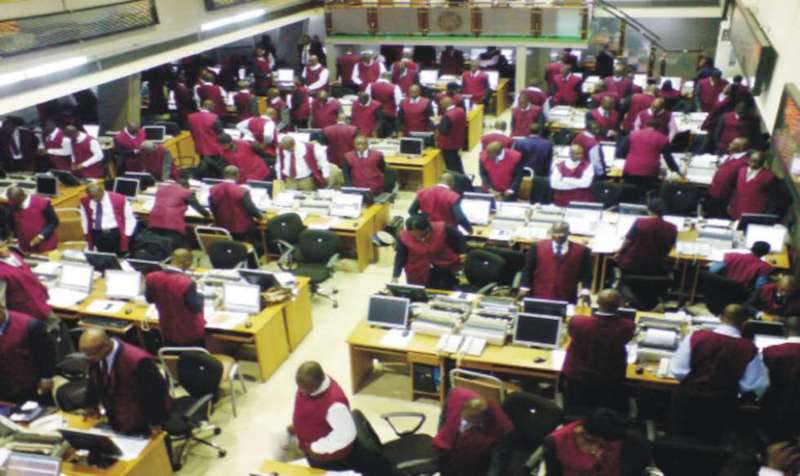
Trading at the stock market remained bearish last week as the Nigerian Stock Exchange (NSE) All-Share Index (ASI) fell further to close lower at 26,536.21.
Trading at the stock market remained bearish last week as the Nigerian Stock Exchange (NSE) All-Share Index (ASI) fell further to close lower at 26,536.21.
After four weeks of growth spurred by
the Central Bank of Nigeria’s (CBN) monetary policy, the
market had
declined by 0.54 per cent the previous week. That depreciation resulted
from investors’ moves to book in part of the profits that were recorded
in the four-week rally.
The negative trend continued last week as more investors sold for cash to meet end-of-year financial commitments among others.
Consequently, the NSE ASI depreciated by
1.19 per cent to close at 26,536.21, while market capitalisation shed
N218.2 billion to close at 12.808 trillion.
Losses were recorded on three of five
trading sessions of the week. For instance, the first two trading days
were bearish as the benchmark index fell 0.7 per cent and 1.1 per cent
in that order. On Wednesday and Thursday, buying interest in MTN Nigeria
Communications Plc, Guaranty Trust Bank Plc and Nigerian Breweries Plc
lifted the market by 0.2 per cent and 0.5 per cent respectively.
However, the last day of the week witnessed a decline of 0.1 per cent.
An analysis of the performance by
sectors showed that the NSE Banking Index and NSE Industrial Goods Index
shed 1.2 per cent apiece. Similarly, the NSE Consumer Goods Index went
down by 0.5 per cent. On the other positive side, the NSE Insurance
Index and NSE Oil & Gas Index appreciated by 0.03 per cent each.
Commenting on the market performance,
analysts at Cordros Capital Limited said given the risk-off sentiment
dominating the domestic market, they expect the market to shed points in
the coming week, “except we see a policy-driven catalyst. Nevertheless,
valuations remain attractive, hence we expect pockets of gains over the
final weeks of the year as fund and portfolio managers realign
portfolios prior to the start of 2020.”
One issue that dominated the capital market space last week was how the government can fund infrastructure through the market.
Speaking at the 2019 annual workshop of Capital Market Correspondents Association of Nigeria(CAMCAN) market stakeholders concluded that the market was capable of providing the funding needed to bridge the infrastructure gap.
Speaking at the 2019 annual workshop of Capital Market Correspondents Association of Nigeria(CAMCAN) market stakeholders concluded that the market was capable of providing the funding needed to bridge the infrastructure gap.
For instance, the acting Director
General, Securities and Exchange Commission (SEC), Ms. Mary Uduk said
there was no better time than now for the federal and state governments
in Nigeria to leverage on the opportunities provided by the capital
market for sourcing infrastructure development financing.
Uduk, who was represented by the Head of
Department, External Relations, SEC, Mr. Sufian Abdulkarim, said the
capital market, “provides an enabling environment for private
investments in infrastructure projects and the SEC is doing its part to
foster this through the implementation of the Capital Market Master Plan
(2015-2025).
“The plan’s major objective is to
transform the Nigerian capital market, making it competitive, while
contributing towards the nation’s development through funds
mobilisation.
“We believe that the establishment of an active infrastructure funds via the capital market as being pursued by capital market stakeholders would be immensely beneficial in closing the infrastructure gaps in the country.
“We believe that the establishment of an active infrastructure funds via the capital market as being pursued by capital market stakeholders would be immensely beneficial in closing the infrastructure gaps in the country.
“The international capital markets are
the largest and deepest pool of financing in the world, and in
conjunction with local capital markets, which represent an essentially
untapped source of funds for infrastructure projects, they can make a
huge contribution to economic development, if effective transaction
structures are developed,” Uduk said.
In the opinion of the Head, Debt Capital
Markets, FBNQuest Merchant Bank Limited, Mr. Oluseun Olatidoye, who was
the guest speaker at the workshop, the capital market represented a
very good platform for raising funding for infrastructure development
going by some landmark transactions in recent years because we “have
funded over portions of 26 roads across the six geopolitical zones in
the country with the sum of N200billion on the FGN Sukuk I and II.”
“We have raised N11.4billion for the
development of primary, middle and secondary school facilities in Osun
State, we have funded the development of affordable housing on the Mixta
Real Estate plc Bond Issues and we have developed a number of roads,
bridges, health facilities using the opportunity presented by the
capital markets,” he added.
Also speaking, the Chief Executive
Officer of the Nigerian Stock Exchange (NSE), Mr. Oscar Onyema, said the
recent study by McKinsey stated that Nigeria needs to attract $31
billion investment annually over 10 years for the country to bridge its
infrastructure gap. However, the 2019 capital expenditure was about $5
billion, which is clearly insufficient in meeting the infrastructure
deficit.
“The investment required is near
impossible relative to government resources. Nigeria would require
different sources of financing both from traditional and new sources
including wider participation of private sector and institutional
investors, pension, insurance and leveraging the capital market
initiatives. It has therefore become necessary to develop innovative
financing solution facilitated by the capital market to bridge,” Onyema,
who was represented by the Head, Trading Division, NSE, Mr. Jude
Chiemeka said.
Market turnover
Despite the decline recorded by the NSE ASI, the value and volume of trading rose to 1.044 billion shares worth N14.628 billion in 14,974 deals last week, from 952.697 million shares valued at N12.774 billion that were exchanged in 17,279 deals the previous week.
Despite the decline recorded by the NSE ASI, the value and volume of trading rose to 1.044 billion shares worth N14.628 billion in 14,974 deals last week, from 952.697 million shares valued at N12.774 billion that were exchanged in 17,279 deals the previous week.
However, the Financial Services industry
remained the most traded with 556.905 million shares valued at N5.678
billion traded in 8,267 deals. Thus, the sector contributed 53.33 per
cent and 38.81 per cent to the total equity turnover volume and value
respectively.
The Healthcare industry followed with
215.030 million shares worth N122.603 million in 412 deals, while the
third place was Conglomerates industry with a turnover of 89.601 million
shares worth N466.294 million in 874 deals.
Trading in the top three equities
namely, Union Diagnostics and Clinical Services Plc, United Bank for
Africa Plc and Guaranty Trust Bank Plc accounted for 379.095 million
shares worth N3.066 billion in 1,704 deals, contributing 36.3 per cent
and 20.96 per cent to the total equity turnover volume and value
respectively.
Top price gainers and losers
The price movement chart showed that 44 equities depreciated in price, higher than 35 equities of the previous week, while 18 equities appreciated lower than 19 equities in the previous week.
Chams Plc led the price losers with 18.9 per cent followed Union Diagnostic & Clinical Services Plc with 15.3 per cent. Glaxosmithkline Consumer Nigeria Plc depreciated by 12.5 per cent just as Cutix Plc shed 11.6 per cent.
The price movement chart showed that 44 equities depreciated in price, higher than 35 equities of the previous week, while 18 equities appreciated lower than 19 equities in the previous week.
Chams Plc led the price losers with 18.9 per cent followed Union Diagnostic & Clinical Services Plc with 15.3 per cent. Glaxosmithkline Consumer Nigeria Plc depreciated by 12.5 per cent just as Cutix Plc shed 11.6 per cent.
Daar Communications Plc and Berger
Paints Nigeria Plc declined 10 per cent apiece while Arbico Plc shed 9.9
per cent. Other top price losers included: Chellarams Plc (9.7 per
cent); Neimeth International Pharmaceuticals Plc(9.5 per cent) and Niger
Insurance Plc (9.0 per cent).
On the positive side, Presco Plc led the price gainers with 14.9 per
cent trailed by Dangote Sugar Refinery Plc with 10.3 per cent. AXA
Mansard Insurance Plc appreciated by 9.9 per cent, just as A.G Leventis
Nigeria Plc chalked up 8.3 per cent. Eterna Plc garnered 7.1 per cent,
while Cornerstone Insurance Plc and Ekocorp Plc gained 4.7 per cent and
3.7 per cent respectively.Other top price gainers were:NPF Microfinance Plc (3.6 per cent); UAC of Nigeria Plc (3.4 per cent); and Fidelity Bank Plc (2.9 per cent).
No comments :
Post a Comment