


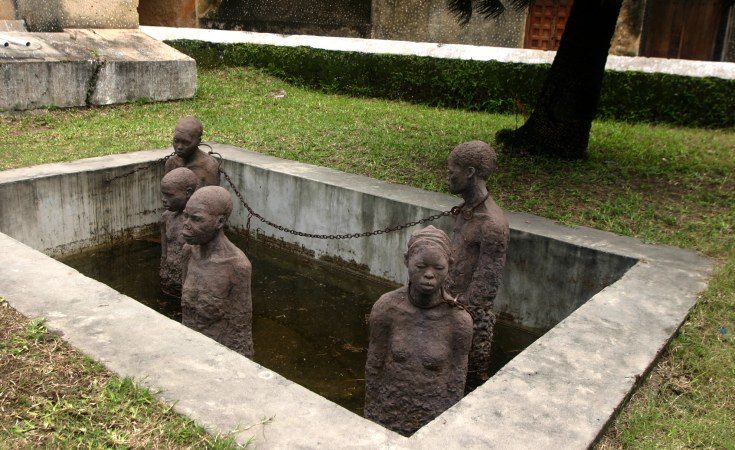
Memory for the Slaves sculpture in Zanzibar. The artist is Clara Sörnäs.
22 August 2019
Over several
centuries countless East Africans were sold as slaves by Muslim Arabs to
the Middle East and other places via the Sahara desert and Indian
Ocean. Experts say it is time for this to be discussed more openly.
The island of
Zanzibar is today considered one of East Africa's best destinations:
white sandy beaches, crystal clear waters and hotels offer tourists from
all over the world a holiday to remember.
Long forgotten is
the dark past that overshadowed this sunny paradise 200 years ago. The
archipelago, which today is a semi-autonomous part of Tanzania, was then
regarded as the center of the East African slave trade.
In addition to
valuable raw materials such as ivory and the coveted cloves, one thing
stood out above all others in the colorful markets: hundreds of slaves.
From Eastern Europe to North Africa
The sale of African
slaves can be traced back to antiquity. It became popular in the
seventh century when Islam was gaining strength in North Africa. This
was seven centuries before Europeans explored the continent and ten
centuries before West Africans were sold across the Atlantic to America.
Back then, Arab
Muslims in North and East Africa sold captured Africans to the Middle
East. There, they worked as field workers, teachers or harem guards,
which is why the castration of male slaves was common practice. Muslims,
on the other hand, including African Muslims, were not allowed to be
enslaved, according to Islamic legal views.
"Initially, the
Arab Muslims in Eastern and Central Europe took white slaves to sell
them to Arabia," Senegalese author Tidiane N'Diaye told DW in an
interview. "But the growing military power of Europe put an end to
Islamic expansion and now that there was a shortage of slaves, Arab
Muslims were looking massively to black Africa."
Roots of slavery in Africa
According to
N'Diaye, slavery has existed in practically all civilizations. This was
also the case in Africa before settlers came.
In central East
Africa, ethnic groups such as the Yao, Makua and Marava were fighting
against each other and entire peoples within the continent traded with
people they had captured through wars. "Thus Arab Muslims encountered
already existing structures, which facilitated the purchase of slaves
for their purposes."
For Abdulazizi
Lodhi, Emeritus Professor of Swahili and African Linguistics at the
University of Uppsala in Sweden, slavery was part of different African
cultures "When it came to exports, tribal Africans themselves were the
main actors. In many African societies there were no prisons, so people
who were captured were sold."
Zanzibar as East Africa's slave hub
The slave trade in
East Africa really took off from the 17th century. More and more
merchants from Oman settled in Zanzibar. The island took on an even more
important role in the international trade of goods due to the large
trade at the Swahili coast and consequently also in the slave trade.
This is how the largest slave market in East Africa was created.
Only estimates,
some of which vary widely, exist as to how many Africans were sold from
East to North Africa. This is also due to the fact that many of the
slaves perished. Scientific research concludes that about three out of
four slaves died before they reached the market where they were to be
sold. The causes were hunger, illness or exhaustion after long journeys.
Author N'Diaye
estimates that 17 million East Africans were sold into slavery: "Most
people still have the so-called Transatlantic [slave] trade by Europeans
into the New World in mind. But in reality the Arab-Muslim slavery was
much greater," N'diaye said.
"Eight million
Africans were brought from East Africa via the Trans-Saharan route to
Morocco or Egypt. A further nine million were deported to regions on the
Red Sea or the Indian Ocean."
'The spice of slavery'
Historian Lodhi
disagrees with N'Diaye's figure. "17 million? How is that possible if
the total population of Africa at that time might not even have been 40
million? These statistics did not exist back then."
Old reports were
also methodically doubtful. For example, David Livingston, a Scottish
missionary and explorer, estimated that 50,000 slaves were being sold
annually in the markets of Zanzibar. "Even today, the number of people
living in Zanzibar is not close to 50,000. The numbers have neither hand
nor foot," Lodhi said.
Not all slaves were
taken to Egypt or Saudi Arabia. From 1820, Omani settlers began
cultivating cloves in Zanzibar to meet the growing demand on the world
market. Large plantations quickly developed and slaves could be bought
cheaply at the nearby slave market.
From 1839 to 1860,
the quantity of exported cloves increased from 565 (1,246 pounds) to
12,600 kilograms, according to American historian Frederick Cooper.
Zanzibar's reputation changed from being the center of the slave trade
to a center of slave keeping which produced notorious figures such as
the legendary slave trader Tippu-Tip.
The end of slavery?
At the end of
August 1791, a slave revolt began in today's Haiti and the Dominican
Republic. These two uprisings significantly promoted the abolition of
the transatlantic slave trade, slavery and colonialism in Africa.
However, it was not
until 1873 that Sultan Seyyid Barghash of Zanzibar, under pressure from
Great Britain, signed a treaty that made the slave trade in his
territories illegal. That decree was not enforced effectively either. It
was not until 1909 that slavery was finally abolished in East Africa.
According to author
N'Diaye, slavery still exists, albeit in a different form. It is
estimated that nearly 40 million people worldwide still live in slavery.
In Africa there are hundreds of thousands. "In Mauritania they say they
have abolished slavery, but in reality the situation in North Africa
has not changed much. Young people are enslaved against their will,
forced to work and sexually exploited."
There have been
reports from Libya about organized slave markets and a few years ago, a
case of slavery was uncovered in Tanzania, according to Lodhi. "A mine
was found in a remote area where 50 to 60 boys were forced to work. They
were not paid and lived in a camp guarded by armed men."
The effects of
slavery in East Africa are not as severe as the economic consequences of
Western colonization of Africa, says N'Diaye. "The economy of many of
these countries is still dominated by the West; it's a topic being
discussed by many intellectuals. But N'Diaye says that what happened in
East Africa over the centuries should also be openly discussed.
"Most of the
African authors have not yet published a book on the Arab-Muslim slave
trade out of religious solidarity. There are 500 million Muslims in
Africa, and it is better to blame the West than talk about the past
crimes of Arab Muslims."
No comments :
Post a Comment