


Unhealthy
diets pose a massive and growing health threat across the world. In
Africa, traditional foods and inner-city farms could be the answer.
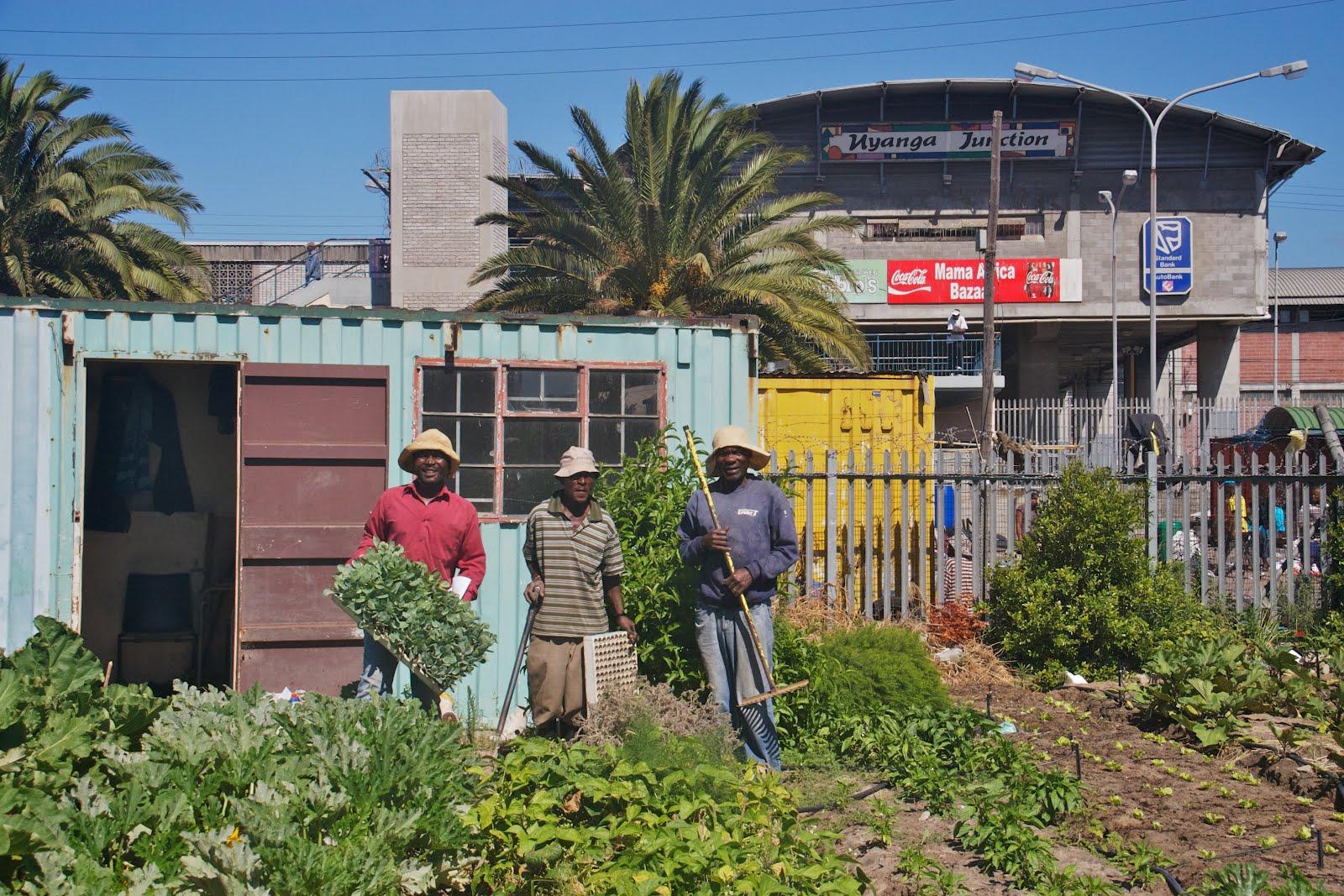
Farmers from Abalimi Bezekhaya, an urban farming initiative in Cape Town. Credit: Ellen Zachos.
many more consume low-quality diets that substantially increase the risks of cardiovascular disease, stroke, diabetes and obesity.
To combat these problems, the EAT-Lancet Commission recommends a “planetary health diet” for everyone over the age of two. This consists of a daily intake of 2,500 calories made up of a “variety of plant-based foods, low amounts of animal-based foods, unsaturated rather than saturated fats, and few refined grains, highly processed foods and added sugars”.
For Africa, achieving the planetary health diet will require a range of initiatives. It will involve investing in innovative farming techniques and educating communities on healthy eating, including of traditional African foods and fortified foods. Since the Lancet report cites urbanisation is a key reason for the rise in unhealthy eating, one part of the solution will also be for Africa to boost food production in its cities.
To do this, Africa must invest in innovative urban farming practices to ensure healthier foods are available to everyone. Some regions are already trying this. In South Africa, for example, the Western Cape Department of Agriculture actively encourages citizens to grow crops in urban areas. Meanwhile, in Kenya, backyard farming is becoming increasingly common despite negligible government support.
But much more must be done. To begin with, African governments need to get a better grasp of current farming practices. City officials, for instance, should map and publicise existing urban agriculture initiatives. This will help shape future policy, allow urban farmers to connect with each other, and make it easier for potential funders to identify promising initiatives.
Governments must also increase material, technical and informational support to urban farmers. This could include improving access to extension services, agricultural inputs, finance and insurance. Urban farmers could particularly benefit from help developing business plans and other technical advice. This could come from the government, NGOs, educational bodies or other organisations. A recent study in Accra, Ghana, for example, found that educating urban vegetable farmers on sources of agricultural information could be hugely significant.
Another strategy to promote urban farming would be to provide guaranteed markets. Governments could mandate public institutions such as hospitals and schools to buy a portion of their food from urban farmers. Meanwhile, non-profit and other organisations could partner with agricultural initiatives to grow locally-relevant, affordable and nutritional foods.
In these such initiatives, governments could provide particular incentives for farmers who cultivate native crops such as millet, sorghum, leafy vegetables and drought-tolerant protein-rich legumes such as cowpeas and mung beans. These foods have been eaten by many generations and are not only healthy and nutritious but better for the environment since they do not require a lot of agricultural inputs.
In fact, a study found that consuming traditional African vegetables can increase both household nutrition security and dietary diversity, particularly for children under five. This is especially important as, in 2017, there were 151 million children under age five who were stunted, 51 million wasted and 38 million overweight according to the World Health Organisation.
Among other things, these familiar foods could be used in the supplements that are incorporated into the foods mothers give children after six months of breastfeeding. These supplements are already made from peanuts, but it is possible that similar foodstuffs could be developed from other protein-rich legumes that grow well in much of Africa such as cowpeas. This could increase the range of products used to tackle the double burden of malnutrition and food insecurity. Women of child-bearing age would also benefit from the greater availability of foods that are rich in iron and folic acid, which are necessary for production of red blood cells and proper development of the foetus.
As Africa, and the world, faces the huge health threat from both the lack of food and poor diets, it is reassuring that a big part of the solution lies within the continent and its long and knowledge-rich agricultural history. But efforts to ensure people are well-nourished must be intensified. The challenges are steep, but with the right support and incentives along with a renewed focus on Africa’s native crops, the continent has all the right tools to overcome them.
the committee,
government action in setting up structures to manage the oil industry,
including oil revenues, has been tardy. When discussing management of
the new industry, including formation of the investment committee, the
source says: "The government is firefighting. [...] I was not the only
[member of the investment committee
Full article: https://www.euromoney.com/article/b12kjhrb1p4spc/sovereign-wealth-funds-ghana-joins-african-wealth-fund-scramble?copyrightInfo=true
Visit http://www.euromoney.com/reprints for additional distribution rights. For more articles like this, follow us @euromoney on Twitter.
Full article: https://www.euromoney.com/article/b12kjhrb1p4spc/sovereign-wealth-funds-ghana-joins-african-wealth-fund-scramble?copyrightInfo=true
Visit http://www.euromoney.com/reprints for additional distribution rights. For more articles like this, follow us @euromoney on Twitter.
Sovereign wealth funds:
Ghana joins African wealth fund scramble
By: Dominic O’Neill Published on: Wednesday, March 07, 2012
Eurobond investors seek clarity on oil revenues; Gabon follows with new
sovereign fund
Order
AddThis Sharing Buttons
Share to Print
Share to FacebookShare to TwitterShare to LinkedInShare to WhatsApp
Ghana’s new sovereign wealth fund took a step forward last month:
forward, at least, from its position as little more than a couple of
accounts at the central bank. A new investment advisory committee –
headed by one of the best-known figures in Africa’s business and
financial community – was inaugurated and held its first meeting in
February.
According to the 2011 Petroleum Revenue Management Act, the committee is
supposed to formulate the fund’s investment strategies for the minister
of finance, Kwabena Duffuor. This includes guidelines on
asset-allocation and targeted returns.
Ghana's president, John Atta Mills
John Atta Mills at a ceremony marking the first flow of oil from the
Jubilee offshore oil field in 2010
The law says transparency should be a fundamental principle of
management of the state’s new-found oil wealth. However, Euromoney
understands that the investment committee decided at its initial meeting
to make no official announcement either on its inauguration or
membership, which is appointed, according to the law, by the president,
John Atta Mills, with advice from Duffuor.
Investment committee
The seven-member committee includes a traditional leader from the
country’s oil-producing west coast, someone from the central bank, as
well as Ghanaian experts on law and development policy. The chairman is
Kofi Bucknor, a Ghanaian former treasurer of the African Development
Bank, and more recently known as the main point man for investments in
Africa by Saudi billionaire Prince Al-Waleed Bin Talal.
"The committee has been set up as prescribed by the law, and payments
have been to the fund as required," Bucknor tells Euromoney.
But according to another member of the committee, government action in
setting up structures to manage the oil industry, including oil
revenues, has been tardy. When discussing management of the new
industry, including formation of the investment committee, the source
says: "The government is firefighting. [...] I was not the only [member
of the investment committee] confused about the purpose of our role."
According to the source, such problems have meant that, although the act
says the committee should meet every three months, it has decided to
meet every month, to try to ensure it is better able to perform its
duty. Meanwhile, the investment committee’s scramble to get up and
running has raised questions over how effectively the body designed to
ensure compliance with the Petroleum Revenue Management Act – the Public
Interest and Accountability Committee – has been able to fulfil its
role.
Revenues from oil started to flow into Ghana’s state coffers last year
from exploitable reserves discovered offshore four years ago. The
interval from oil discovery to production has been particularly short,
partly because Ghana is eager to reap the profits.
"Pressure to spend has been higher because of the oil discoveries, so in
that sense Ghana has been an oil economy since at least 2008," says
Sebastien Dessus, the World Bank’s lead economist for Ghana.
The rapid development of the oil industry and the associated challenges
for the government have made it critical to assure investors that a
framework is in place to save oil money when energy prices are high. In
2007 Ghana issued a benchmark debut 10-year Eurobond, as did another
African oil exporter, Gabon. Both bonds mentioned oil revenue in their
prospectuses and in recent months rising oil prices have supported both
bonds’ prices.
Partly thanks to oil, GDP growth in Ghana last year was 13.5%, according
to the IMF. However, oil-price volatility means oil revenue is not
without risks for the government’s finances.
Price rises
As is not unusual for countries in an oil boom, Ghana has already seen
rises in property prices and construction, particularly in the
oil-producing west and in the capital, Accra, which is also becoming
something of a hub for West Africa. Some of the bigger local banks are
getting hungrier for risk because of the oil boom. They are financing
nascent construction frenzy.
If there is a bust, the banks’ systemic importance could be a contingent
liability. Meanwhile, in addition to local-currency debt and the $750
million Eurobond, the China Development Bank agreed a $3 billion loan to
Ghana last year, for infrastructure developments carried out by Chinese
contractors. It too is collateralized against oil revenues.
Partly because of overspending during the last election in 2008, Ghana
went to the IMF for a programme, which is due to expire in June. Mills
is up for re-election in December, and the cedi has already lost about
15% of its value against the dollar over the past six months.
On February 15 this year, the central bank said currency volatility and
what it termed fiscal pressures were behind its decision to increase the
base rate by 100 basis points to 13.5%.
The wealth fund should protect the government against all this. From
2011, according to the new law, a minimum of 30% of the Ghanaian state’s
projected oil revenues should have been flowing from the overall
oil-revenue pot at the central bank – the Petroleum Holding Fund – to
the subsidiary Ghana Stabilization Fund and Ghana Heritage Fund. While
the latter is for when the oil runs out, the former is to support the
budget when oil revenues fall below expectations.
Revenues from higher-than-expected prices and production are supposed to
provide additional flows to the two funds. Average global oil prices
have been at least $20 more than the $90 a barrel projected in the
budget so far in 2012.
For 2012, the budget foresaw total revenue from oil sales of an
equivalent of $735 million. But Duffuor has said this year only the
minimum 30% of projected revenue would be transferred into the two
subsidiary funds, leaving the government free to spend the rest
(purportedly on infrastructure and capacity-building in oil and gas).
Last year the government put only $54.8 million into the Stabilization
Fund and $14.4 million into the Heritage Fund.
Searching for surplus
Balance of payments, Ghana, 2008 to 2013, $million
2008 2009 2010 2011E 2012E 2013E
Trade balance -5,000 -2,207 -2,962 -2,881 -1,800 -1,850
Exports 5,269 5,840 7,960 11,869 11,000 12,850
Cocoa 1,487 1,866 2,220 2,650 2,200 2,800
Gold 2,246 2,551 3,804 4,500 4,100 4,750
Oil – – – 2,500 3,050 3,400
Imports -10,269 -8,046 -10,922 -14,750 -12,800 -14,700
Non-oil -7,912 -6,557 -8,686 -11,750 -10,000 -11,500
Oil -2,357 -1,489 -2,236 -3,000 -2,800 -3,200
Net invisibles 1,671 519 262 -850 -825 - 825
Current account -3,328 -1,688 -2,700 -3,730 -2,625 -2,675
% GDP -11.8 -6.5 -8.4 -9.7 -6.8 - 6.3
Source: Bank of Ghana, Ministry of Finance, Morgan Stanley Research
estimates
Gabon
In February, Gabon announced that its sovereign wealth fund (first
created in 1998) would be relaunched as the Sovereign Fund of the
Gabonese Republic. According to research from Standard Bank, the fund
will target a minimum capitalization of the equivalent of $1 billion,
funded by 10% of oil revenue projected in the budget, as well as 50% of
revenue above budget assumptions, plus portfolio dividends.
But the record for saving oil wealth is not propitious in Africa’s other
oil-exporting states. According to Standard Chartered, Nigeria’s Excess
Crude Account, for example, failed to receive inflows commensurate with
rises in prices and production, partly because of politicking around a
presidential election in April 2011.
Nigeria passed a Sovereign Wealth Fund bill through parliament in May,
in an effort to boost savings from oil. The Excess Crude Account was to
be restructured and renamed the Nigerian Sovereign Investment Authority.
But Standard Bank research says sections of the elite are preventing
proper implementation of the bill.
Full article: https://www.euromoney.com/article/b12kjhrb1p4spc/sovereign-wealth-funds-ghana-joins-african-wealth-fund-scramble?copyrightInfo=true
Visit http://www.euromoney.com/reprints for additional distribution rights. For more articles like this, follow us @euromoney on Twitter.
Full article: https://www.euromoney.com/article/b12kjhrb1p4spc/sovereign-wealth-funds-ghana-joins-african-wealth-fund-scramble?copyrightInfo=true
Visit http://www.euromoney.com/reprints for additional distribution rights. For more articles like this, follow us @euromoney on Twitter.
Sovereign wealth funds:
Ghana joins African wealth fund scramble
By: Dominic O’Neill Published on: Wednesday, March 07, 2012
Eurobond investors seek clarity on oil revenues; Gabon follows with new
sovereign fund
Order
AddThis Sharing Buttons
Share to Print
Share to FacebookShare to TwitterShare to LinkedInShare to WhatsApp
Ghana’s new sovereign wealth fund took a step forward last month:
forward, at least, from its position as little more than a couple of
accounts at the central bank. A new investment advisory committee –
headed by one of the best-known figures in Africa’s business and
financial community – was inaugurated and held its first meeting in
February.
According to the 2011 Petroleum Revenue Management Act, the committee is
supposed to formulate the fund’s investment strategies for the minister
of finance, Kwabena Duffuor. This includes guidelines on
asset-allocation and targeted returns.
Ghana's president, John Atta Mills
John Atta Mills at a ceremony marking the first flow of oil from the
Jubilee offshore oil field in 2010
The law says transparency should be a fundamental principle of
management of the state’s new-found oil wealth. However, Euromoney
understands that the investment committee decided at its initial meeting
to make no official announcement either on its inauguration or
membership, which is appointed, according to the law, by the president,
John Atta Mills, with advice from Duffuor.
Investment committee
The seven-member committee includes a traditional leader from the
country’s oil-producing west coast, someone from the central bank, as
well as Ghanaian experts on law and development policy. The chairman is
Kofi Bucknor, a Ghanaian former treasurer of the African Development
Bank, and more recently known as the main point man for investments in
Africa by Saudi billionaire Prince Al-Waleed Bin Talal.
"The committee has been set up as prescribed by the law, and payments
have been to the fund as required," Bucknor tells Euromoney.
But according to another member of the committee, government action in
setting up structures to manage the oil industry, including oil
revenues, has been tardy. When discussing management of the new
industry, including formation of the investment committee, the source
says: "The government is firefighting. [...] I was not the only [member
of the investment committee] confused about the purpose of our role."
According to the source, such problems have meant that, although the act
says the committee should meet every three months, it has decided to
meet every month, to try to ensure it is better able to perform its
duty. Meanwhile, the investment committee’s scramble to get up and
running has raised questions over how effectively the body designed to
ensure compliance with the Petroleum Revenue Management Act – the Public
Interest and Accountability Committee – has been able to fulfil its
role.
Revenues from oil started to flow into Ghana’s state coffers last year
from exploitable reserves discovered offshore four years ago. The
interval from oil discovery to production has been particularly short,
partly because Ghana is eager to reap the profits.
"Pressure to spend has been higher because of the oil discoveries, so in
that sense Ghana has been an oil economy since at least 2008," says
Sebastien Dessus, the World Bank’s lead economist for Ghana.
The rapid development of the oil industry and the associated challenges
for the government have made it critical to assure investors that a
framework is in place to save oil money when energy prices are high. In
2007 Ghana issued a benchmark debut 10-year Eurobond, as did another
African oil exporter, Gabon. Both bonds mentioned oil revenue in their
prospectuses and in recent months rising oil prices have supported both
bonds’ prices.
Partly thanks to oil, GDP growth in Ghana last year was 13.5%, according
to the IMF. However, oil-price volatility means oil revenue is not
without risks for the government’s finances.
Price rises
As is not unusual for countries in an oil boom, Ghana has already seen
rises in property prices and construction, particularly in the
oil-producing west and in the capital, Accra, which is also becoming
something of a hub for West Africa. Some of the bigger local banks are
getting hungrier for risk because of the oil boom. They are financing
nascent construction frenzy.
If there is a bust, the banks’ systemic importance could be a contingent
liability. Meanwhile, in addition to local-currency debt and the $750
million Eurobond, the China Development Bank agreed a $3 billion loan to
Ghana last year, for infrastructure developments carried out by Chinese
contractors. It too is collateralized against oil revenues.
Partly because of overspending during the last election in 2008, Ghana
went to the IMF for a programme, which is due to expire in June. Mills
is up for re-election in December, and the cedi has already lost about
15% of its value against the dollar over the past six months.
On February 15 this year, the central bank said currency volatility and
what it termed fiscal pressures were behind its decision to increase the
base rate by 100 basis points to 13.5%.
The wealth fund should protect the government against all this. From
2011, according to the new law, a minimum of 30% of the Ghanaian state’s
projected oil revenues should have been flowing from the overall
oil-revenue pot at the central bank – the Petroleum Holding Fund – to
the subsidiary Ghana Stabilization Fund and Ghana Heritage Fund. While
the latter is for when the oil runs out, the former is to support the
budget when oil revenues fall below expectations.
Revenues from higher-than-expected prices and production are supposed to
provide additional flows to the two funds. Average global oil prices
have been at least $20 more than the $90 a barrel projected in the
budget so far in 2012.
For 2012, the budget foresaw total revenue from oil sales of an
equivalent of $735 million. But Duffuor has said this year only the
minimum 30% of projected revenue would be transferred into the two
subsidiary funds, leaving the government free to spend the rest
(purportedly on infrastructure and capacity-building in oil and gas).
Last year the government put only $54.8 million into the Stabilization
Fund and $14.4 million into the Heritage Fund.
Searching for surplus
Balance of payments, Ghana, 2008 to 2013, $million
2008 2009 2010 2011E 2012E 2013E
Trade balance -5,000 -2,207 -2,962 -2,881 -1,800 -1,850
Exports 5,269 5,840 7,960 11,869 11,000 12,850
Cocoa 1,487 1,866 2,220 2,650 2,200 2,800
Gold 2,246 2,551 3,804 4,500 4,100 4,750
Oil – – – 2,500 3,050 3,400
Imports -10,269 -8,046 -10,922 -14,750 -12,800 -14,700
Non-oil -7,912 -6,557 -8,686 -11,750 -10,000 -11,500
Oil -2,357 -1,489 -2,236 -3,000 -2,800 -3,200
Net invisibles 1,671 519 262 -850 -825 - 825
Current account -3,328 -1,688 -2,700 -3,730 -2,625 -2,675
% GDP -11.8 -6.5 -8.4 -9.7 -6.8 - 6.3
Source: Bank of Ghana, Ministry of Finance, Morgan Stanley Research
estimates
Gabon
In February, Gabon announced that its sovereign wealth fund (first
created in 1998) would be relaunched as the Sovereign Fund of the
Gabonese Republic. According to research from Standard Bank, the fund
will target a minimum capitalization of the equivalent of $1 billion,
funded by 10% of oil revenue projected in the budget, as well as 50% of
revenue above budget assumptions, plus portfolio dividends.
But the record for saving oil wealth is not propitious in Africa’s other
oil-exporting states. According to Standard Chartered, Nigeria’s Excess
Crude Account, for example, failed to receive inflows commensurate with
rises in prices and production, partly because of politicking around a
presidential election in April 2011.
Nigeria passed a Sovereign Wealth Fund bill through parliament in May,
in an effort to boost savings from oil. The Excess Crude Account was to
be restructured and renamed the Nigerian Sovereign Investment Authority.
But Standard Bank research says sections of the elite are preventing
proper implementation of the bill.
Full article: https://www.euromoney.com/article/b12kjhrb1p4spc/sovereign-wealth-funds-ghana-joins-african-wealth-fund-scramble?copyrightInfo=true
Visit http://www.euromoney.com/reprints for additional distribution rights. For more articles like this, follow us @euromoney on Twitter.
Full article: https://www.euromoney.com/article/b12kjhrb1p4spc/sovereign-wealth-funds-ghana-joins-african-wealth-fund-scramble?copyrightInfo=true
Visit http://www.euromoney.com/reprints for additional distribution rights. For more articles like this, follow us @euromoney on Twitter.
Sovereign wealth funds:
Ghana joins African wealth fund scramble
By: Dominic O’Neill Published on: Wednesday, March 07, 2012
Eurobond investors seek clarity on oil revenues; Gabon follows with new
sovereign fund
Order
AddThis Sharing Buttons
Share to Print
Share to FacebookShare to TwitterShare to LinkedInShare to WhatsApp
Ghana’s new sovereign wealth fund took a step forward last month:
forward, at least, from its position as little more than a couple of
accounts at the central bank. A new investment advisory committee –
headed by one of the best-known figures in Africa’s business and
financial community – was inaugurated and held its first meeting in
February.
According to the 2011 Petroleum Revenue Management Act, the committee is
supposed to formulate the fund’s investment strategies for the minister
of finance, Kwabena Duffuor. This includes guidelines on
asset-allocation and targeted returns.
Ghana's president, John Atta Mills
John Atta Mills at a ceremony marking the first flow of oil from the
Jubilee offshore oil field in 2010
The law says transparency should be a fundamental principle of
management of the state’s new-found oil wealth. However, Euromoney
understands that the investment committee decided at its initial meeting
to make no official announcement either on its inauguration or
membership, which is appointed, according to the law, by the president,
John Atta Mills, with advice from Duffuor.
Investment committee
The seven-member committee includes a traditional leader from the
country’s oil-producing west coast, someone from the central bank, as
well as Ghanaian experts on law and development policy. The chairman is
Kofi Bucknor, a Ghanaian former treasurer of the African Development
Bank, and more recently known as the main point man for investments in
Africa by Saudi billionaire Prince Al-Waleed Bin Talal.
"The committee has been set up as prescribed by the law, and payments
have been to the fund as required," Bucknor tells Euromoney.
But according to another member of the committee, government action in
setting up structures to manage the oil industry, including oil
revenues, has been tardy. When discussing management of the new
industry, including formation of the investment committee, the source
says: "The government is firefighting. [...] I was not the only [member
of the investment committee] confused about the purpose of our role."
According to the source, such problems have meant that, although the act
says the committee should meet every three months, it has decided to
meet every month, to try to ensure it is better able to perform its
duty. Meanwhile, the investment committee’s scramble to get up and
running has raised questions over how effectively the body designed to
ensure compliance with the Petroleum Revenue Management Act – the Public
Interest and Accountability Committee – has been able to fulfil its
role.
Revenues from oil started to flow into Ghana’s state coffers last year
from exploitable reserves discovered offshore four years ago. The
interval from oil discovery to production has been particularly short,
partly because Ghana is eager to reap the profits.
"Pressure to spend has been higher because of the oil discoveries, so in
that sense Ghana has been an oil economy since at least 2008," says
Sebastien Dessus, the World Bank’s lead economist for Ghana.
The rapid development of the oil industry and the associated challenges
for the government have made it critical to assure investors that a
framework is in place to save oil money when energy prices are high. In
2007 Ghana issued a benchmark debut 10-year Eurobond, as did another
African oil exporter, Gabon. Both bonds mentioned oil revenue in their
prospectuses and in recent months rising oil prices have supported both
bonds’ prices.
Partly thanks to oil, GDP growth in Ghana last year was 13.5%, according
to the IMF. However, oil-price volatility means oil revenue is not
without risks for the government’s finances.
Price rises
As is not unusual for countries in an oil boom, Ghana has already seen
rises in property prices and construction, particularly in the
oil-producing west and in the capital, Accra, which is also becoming
something of a hub for West Africa. Some of the bigger local banks are
getting hungrier for risk because of the oil boom. They are financing
nascent construction frenzy.
If there is a bust, the banks’ systemic importance could be a contingent
liability. Meanwhile, in addition to local-currency debt and the $750
million Eurobond, the China Development Bank agreed a $3 billion loan to
Ghana last year, for infrastructure developments carried out by Chinese
contractors. It too is collateralized against oil revenues.
Partly because of overspending during the last election in 2008, Ghana
went to the IMF for a programme, which is due to expire in June. Mills
is up for re-election in December, and the cedi has already lost about
15% of its value against the dollar over the past six months.
On February 15 this year, the central bank said currency volatility and
what it termed fiscal pressures were behind its decision to increase the
base rate by 100 basis points to 13.5%.
The wealth fund should protect the government against all this. From
2011, according to the new law, a minimum of 30% of the Ghanaian state’s
projected oil revenues should have been flowing from the overall
oil-revenue pot at the central bank – the Petroleum Holding Fund – to
the subsidiary Ghana Stabilization Fund and Ghana Heritage Fund. While
the latter is for when the oil runs out, the former is to support the
budget when oil revenues fall below expectations.
Revenues from higher-than-expected prices and production are supposed to
provide additional flows to the two funds. Average global oil prices
have been at least $20 more than the $90 a barrel projected in the
budget so far in 2012.
For 2012, the budget foresaw total revenue from oil sales of an
equivalent of $735 million. But Duffuor has said this year only the
minimum 30% of projected revenue would be transferred into the two
subsidiary funds, leaving the government free to spend the rest
(purportedly on infrastructure and capacity-building in oil and gas).
Last year the government put only $54.8 million into the Stabilization
Fund and $14.4 million into the Heritage Fund.
Searching for surplus
Balance of payments, Ghana, 2008 to 2013, $million
2008 2009 2010 2011E 2012E 2013E
Trade balance -5,000 -2,207 -2,962 -2,881 -1,800 -1,850
Exports 5,269 5,840 7,960 11,869 11,000 12,850
Cocoa 1,487 1,866 2,220 2,650 2,200 2,800
Gold 2,246 2,551 3,804 4,500 4,100 4,750
Oil – – – 2,500 3,050 3,400
Imports -10,269 -8,046 -10,922 -14,750 -12,800 -14,700
Non-oil -7,912 -6,557 -8,686 -11,750 -10,000 -11,500
Oil -2,357 -1,489 -2,236 -3,000 -2,800 -3,200
Net invisibles 1,671 519 262 -850 -825 - 825
Current account -3,328 -1,688 -2,700 -3,730 -2,625 -2,675
% GDP -11.8 -6.5 -8.4 -9.7 -6.8 - 6.3
Source: Bank of Ghana, Ministry of Finance, Morgan Stanley Research
estimates
Gabon
In February, Gabon announced that its sovereign wealth fund (first
created in 1998) would be relaunched as the Sovereign Fund of the
Gabonese Republic. According to research from Standard Bank, the fund
will target a minimum capitalization of the equivalent of $1 billion,
funded by 10% of oil revenue projected in the budget, as well as 50% of
revenue above budget assumptions, plus portfolio dividends.
But the record for saving oil wealth is not propitious in Africa’s other
oil-exporting states. According to Standard Chartered, Nigeria’s Excess
Crude Account, for example, failed to receive inflows commensurate with
rises in prices and production, partly because of politicking around a
presidential election in April 2011.
Nigeria passed a Sovereign Wealth Fund bill through parliament in May,
in an effort to boost savings from oil. The Excess Crude Account was to
be restructured and renamed the Nigerian Sovereign Investment Authority.
But Standard Bank research says sections of the elite are preventing
proper implementation of the bill.
Full article: https://www.euromoney.com/article/b12kjhrb1p4spc/sovereign-wealth-funds-ghana-joins-african-wealth-fund-scramble?copyrightInfo=true
Visit http://www.euromoney.com/reprints for additional distribution rights. For more articles like this, follow us @euromoney on Twitter.
Full article: https://www.euromoney.com/article/b12kjhrb1p4spc/sovereign-wealth-funds-ghana-joins-african-wealth-fund-scramble?copyrightInfo=true
Visit http://www.euromoney.com/reprints for additional distribution rights. For more articles like this, follow us @euromoney on Twitter.
No comments :
Post a Comment