Many white settlers stayed around Mau Forest
by 1940s – and it would not be surprising that they had built air-raid
shelters just in case the bombs started dropping from the skies.
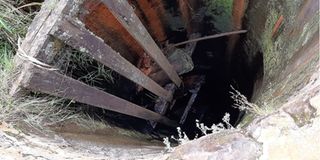
The exit, also made of a charred and haggard turret, has visible steel staircases with eight ladders.
The discovery of a World War II bomb shelter in Eastern Mau has
renewed interest on what else lies within the expansive Mau Forest.
Historians and National Museums had no clue of its existence.
While locals estimate the tunnel is five kilometres long, the Nation
was unable to access the entire length of the structure, akin to other
bomb shelters built in World War II battle zones. If confirmed, this
could be the first bomb shelter to come to historians’ attention better
still, on the anniversary of the start of World War II.
“This is exciting to us. We shall send an expedition of scientists
with different skills to the shelter and we shall have it preserved,”
said Dr Mzalendo Kibunjia, the National Museums Director General.
“We have not had a bomb shelter in Kenya…”
Stella Cherono | Nation Media Group
Many white settlers stayed around Mau Forest by 1940s – and it would
not be surprising that they had built air-raid shelters just in case
the bombs started dropping from the skies.
British allies fought against the Italians in the East African
campaign, as part of World War II, between June 1940 and November
1941.The Italian forces invaded Ethiopia in May 1936 in their bid to
establish Italian East Africa.
The Italians had started their bombings in Wajir before they were
pushed back from Kenya, which was the base of two East African brigades
of the King's African Rifles (KAR) – the Northern Brigade and a Southern
Brigade comprising a reconnaissance regiment, a light artillery battery
and the 22nd Mountain Battery Royal Indian Artillery (RIA). More
regiments had also arrived from South Africa as more bombings started in
Taveta.
Stella Cherono | Nation Media Group
Prisoners of War
While locals say the tunnel was built by Italians, there is little
likelihood they built it for themselves since by the time the Italians
were brought to the Rift Valley basin, they were already Prisoners of
War (POW). That was the time they built the old Mai Mahiu road and the
little Italian church.
Mzee Joseph Chemaina recalls his father saying the structure was built by Italians who were brought in phases.
“My father told me that towards the completion of the construction,
the British company that constructed the tunnel took the local Ogiek,
who had settled at the edges of the forest, to finish the construction
of the underground tunnel, the shelters and the concrete safes located
inside towards the end of the tunnel,” he said.
There is also a likelihood that it was built by the Italian
cooperators who enjoyed more freedom and could work on nearby farms and
road projects while the non-cooperators were left in prison camps.
Locals say there was a loud explosion inside the tunnel in 1997, that
left a 12-metre crater. They also claim that part of the tunnel was
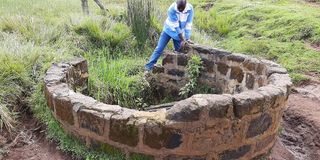
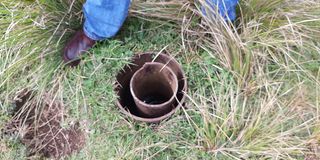
blocked after the explosion. History buff Alex Tanki looks inside one of the eight breathers of the tunnel.
Stella Cherono | Nation Media Group
The Nation team toured the inside of the tunnel but we could
not get to the end because of the blockade just after a deeper moat.
Apart from bats resting on the round, smooth, stone surfaces, there is
no other sign of life, and a little water was flowing on the ground.
Circular turret
The circular tunnel starts from a forest in Marioshoni - which Mr
Chesaina says was initially known as ‘Marisione’- and heads straight to
the hill top, where a circular turret provides an exit which those who
entered the tunnel earlier say is mid-way.
“From there, the tunnel is made of very heavy steel and it leads to
concrete bunkers and shelters fastened with steel doors. There are huge
concrete safes next to each bunker, and all of them cannot be moved. The
shelters are locked with blast and steel doors that have a lock with a
round handle that looks like a steering wheel,” history enthusiast Alex
Tanki, who had previously ventured inside told us. Another resident,
Filax Sembui who explored the tunnel before the blast said that from
there are diversions inside the tunnel’s tail end where the shelters are
located, and that the main exit is located at in the middle of the
shelters.
“When inside the tunnel, where the huge shelters are, you can see
spiral steel staircases that ascend towards the earth surface. From this
point, the surface of the earth looks farther because the exit is at
the top of a hill. Using a Global Positioning System technology and map,
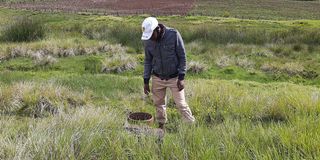
the Nation noted that the second exit is located at exactly 4.87 kilometres from the entrance hidden next to a stream.
Stella Cherono | Nation Media Group
The exit, also made of a charred and haggard turret, has visible
steel staircases with eight ladders. Mr Chemaina said initially, the
steel ladders were ten, and that the top most two were removed by
unknown people. Next to the exit is the huge hole created by the 1997
explosion.
It is now filled with water. Also located at the hill top are eight
breathers purported to have been used as ventilation exhausts.

 World War II tunnel excites historians




No comments:
Post a Comment