
By Lekan Babalola
Industrialisation
is the process by which an economy moves from primarily agrarian
production to mass-produced, technologically advanced goods and
services. This phase is characterised by exponential leaps in
productivity, shifts from rural to urban labour, and increased standards
of living. By typical measurements, such as income per capita or labor
productivity, industrialisation can be
considered the most important
economic development in human history.
Economic
historian Deirdre McCloskey, writing in the Cambridge University Press
in 2004, argued that industrialisation was “certainly the most important
event in the history of humanity since the domestication of animals and
plants, perhaps the most important since the invention of language.”
Not all historians agree with the spark that ignited the Industrial
Revolution. Most economists point to the changes in legal and cultural
foundations in Great Britain that allowed free trade and gave
entrepreneurs, the room and incentives to take risks, innovate, and
profit.
Having
given a background information of the pivotal role industrialisation
plays in any economy, it is pertinent that I bring to fore, the
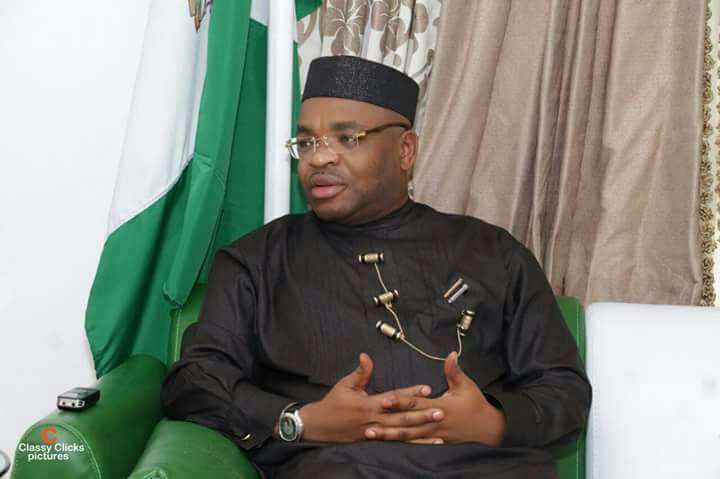
improvements that Governor Emmanuel Udom has brought to Akwa Ibom State.
Before
Emmanuel Udom came into office on May 29 2015, Akwa Ibom was rated as
one of the states with the highest income inequality peaking at over
0.54 for the self-employed (predominantly farmers), and 0.44 for the
employed-salary paid/wage earners, (UNDP, 2012). Akwa Ibom was also
mentioned as the third state with the highest poverty rate of 27.1%
within the south-south zone after Cross River State (31.2%) and Bayelsa
state (32.5%), (UNDP, 2012) Eugene (2012) and World Bank (2010).
National Bureau of Statistics (201) reported that Akwa Ibom State has
the second highest unemployment rate of over 25.8% after Delta state in
the south-south zone, but leads other states in the zone in terms of
income generating opportunities. Adebayo (2002) and Batchelder (2010)
showed that, income volatility exists in some rural and urban areas.
Akwa Ibom State was also classified as a predominantly civil service state with the government being the major engine of growth.
The main
economic activities of the people are fishing (for riverine and coastal
dwellers), farming (mostly for upland dwellers), trading, artisanship
and white-collar services.
The
robust public sector employed a significant proportion of the states
labour force, and a Gross Domestic Product (GDP) of US$11,179m pre-Udom
era.
Thus the
task before Emmanuel Udom was beyond words but to design an economic
framework that would positively turnaround the realities of the state
for growth through a well structured industrialization drive spread
across all major sectors of the State’s economy. He made the promise on
his inauguration when in his speech he said, “I have plans to transform
the economy of our state through industrialisation and sustained
public-private sector initiative, thereby opening up opportunities for
growth and improved living standards”.
To get
by with his commitment, He ensured the provision of the much-needed
legal protections against political and regulatory risks through the
state House of Assembly for investors and placed premium importance on
peace and security; to keep investors’ confidence high in the state as
safe for investment.
In
discussing industrialisation in Akwa Ibom, there are identifiable
projects executed or ongoing towards the much talked about industrial
revolution. There are some projects completed and operational, some are
ongoing while some were refurbished/resuscitated and now operational.
The
Electric Digital Metering Solutions Manufacturing Factory, Syringe
Manufacturing Factory (Largest in Africa), and Pencil Factory and
Toothpick factory are examples of projects under the industrialisation
agenda which have been completed and are operating at optimal
capacities.
It is
worthy of note that the syringe company has the capacity to produce a
billion a year, while the Electric Digital Metering Solutions
Manufacturing Factory will ensure electricity companies bill Nigerians
accurately. Recently, the Port Harcourt Power Holding Electricity
Distribution (PHED) and some others in the Niger Delta region ordered
over one million meters from the company.
The
Flour Mills and Coconut Refinery, Ibom Deep Seaport, Ibom Industrial
Park/ Jetty, Plastic Manufacturing Factory and Fertilizer Blending
Factory, and construction of 33 Cassava Micro-processing mills are all
ongoing projects in the economic diversification agenda of the Governor.
Lastly,
the resuscitation of Peacock Paint Industry and refurbishing of Cassava
Processing Factories located at Ikot Okudom, Eket LGA; Nung Udoe,
Ibesikpo/Asutan LGA and Ikot Ekang in Abak LGA which was leased to
private operators for the production of high quality garri, odorless
foofoo and cassava flour are examples of revived factories which were
once in a comatose state and made operational. The expected impact of
the industrialization embarked upon by Emmanuel Udom is evident in every
projected and present economic variables.
The
National Bureau of Statistics rated has listed Lagos, Akwa Ibom, Ogun,
Oyo, Rivers states and the Federal Capital Territory, Abuja as the most
investors-friendly destinations in the country in the first quarter of
2017.
The
report also showed that while Akwa Ibom, which is a major tourism hub of
the country, attracted $18.361m capital importation. The bureau noted
that this year’s record showed a 27.75 per cent improvement over the
country’s achievements of previous years.
Akwa
Ibom State is presently experiencing rapid economic transformation,
much faster than the Nigerian average. The quality of life index has
grown to more than 300% in only almost years.
Under
the period in review, Akwa Ibom state has transformed into a capital
intensive economy rather than a labour intensive one, as well as a
knowledge driven economy for global competiveness while becoming
Nigeria’s 3rd wealthiest State out of 36 in GDP– estimated at N 6,157
billion annually (approx. USD$31bn) and a GDP per capita well above
national average at US$ 6,120 per head.
The
good people of Akwa Ibom should start celebrating as they have a very
huge Return of Investment. It is evident in the day-to-activities of
Government and the people of Akwa Ibom, as it is impactful on the lives
of every citizen of the state. Thousands of direct and ancillary jobs
are being created and the skills set of the people is improved. Also
improved are economies of scale built around these industries, all of
which put money in the hands of the people.
It
must also be said that while presently, people of Akwa Ibom may not
comprehend the significance of Emmanuel’s industrial revolution mission
fully, in years to come, these companies which are mostly startups
today, in relation to their size and capacity would grow to become
conglomerates especially when you put into consideration the wisdom to
float the companies as public-private-partnerships (PPP). This is the
model that brought about Chaebols and the Zaibatsus from family
start-ups into global reckoning as conglomerates in what is today
regarded as the Asian industrialisation.
––Babalola writes from Abuja
No comments:
Post a Comment