


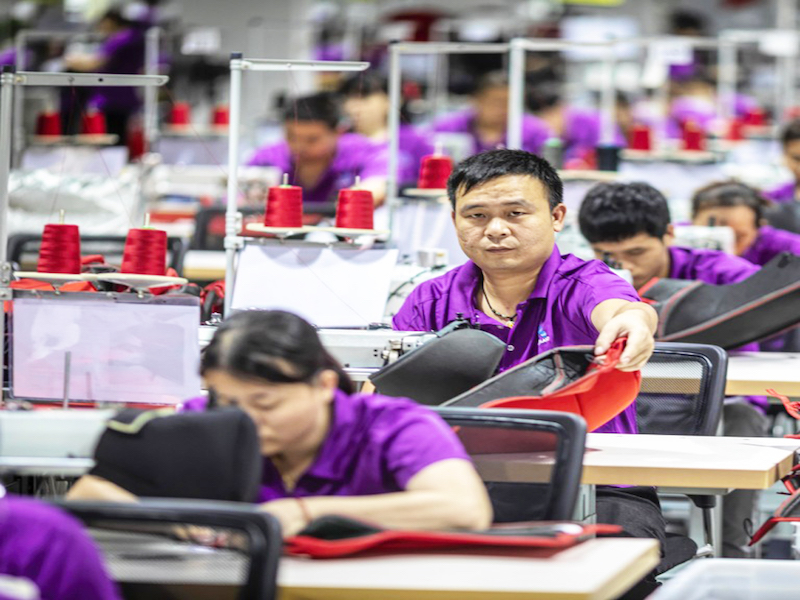
With stakes worth billions of
dollars in businesses ranging from agriculture to oil, gas, and
construction, China’s Greek-gift economic assistance is increasing
unemployment and worsening job creation in Nigeria. THISDAY
investigations revealed that China’s exploitative business model is
hinged on economic sabotage and security breaches. Adedayo Adejobi
reports
In Nigeria and across Africa, Chinese
investments evoke and provoke widespread suspicion of a new form of
colonialism as well as praise, but for the most part, their coming and
stay, attract undue attention, privileges whilst they flout existing
operational guidelines and prevailing business principles by hook or by
crook.
As China emerged as a significant world
economic power, its own need for natural resources increased. To meet
its demand, China is importing vast amounts of resources such as copper
and oil from Africa to feed its production of furniture, wood
processing, medicine, computers, transportation equipment, and textiles.
They have stakes worth billions of dollars in everything from
agriculture to construction.
China’s investments in Nigeria’s economy
have also hindered political reforms in the country. China’s economic
assistance is increasing unemployment and worsening job creation in
Africa. In the midst of the investments, exports, and new
infrastructure, China is blatantly ignoring its promise to bring about
change.
Chinese firms in Nigeria also practice
illegal methods to achieve their goals. For instance, by law, mining on
small plots of 25 acres or less is restricted to Nigerian nationals.
However, China continues to explore for gold and other precious stones
in conjunction with local landowners, even though regulations have made
it clear that such practice is illegal. The methods in which they
exploit Nigeria’s resources are endless and affect the local and
domestic economy.
Chinese corporations are all over
Africa. In June 2017, a McKinsey & Company report estimated that
there are more than 10,000 Chinese-owned firms operating in Africa.
The reason Chinese corporations are in
Africa is simple; to exploit the people and take their resources. It’s
the same thing European colonists did during mercantile times, except
worse. The Chinese corporations are trying to turn Africa into another
Chinese continent.
They are squeezing Africa for everything it is worth.
Globalization managed to skip Africa by
for years. There were several reasons for this. Africa was considered to
have poor infrastructure, political instability, and low income. “The
trade in oil, gas, gems, metals and rare earth minerals wreaks havoc in
Africa. During the years when Brazil, India, China, and the other
“emerging markets” transformed their economies, Africa’s resource states
remained tethered to the bottom of the industrial supply chain.
Everything changed when China came
along. The country was desperate for raw materials and energy to power
its growing manufacturing capacity. The continent was placed right next
to Shanghai in terms of Beijing’s business priorities.
Africa was at the top of the Beijing
economic agenda. It was an easy and convenient target. Chinese leaders
sent business delegations toevery capital in Africa year after year.
These delegates secured infrastructure projects and proposed trade
deals, converting Africa into a “second continent” for China,
metaphorically, speaking.
The long arm of globalization has no
doubt touched Nigeria and the rest of Africa. Trade between China and
the “second continent” of Africa reached close to $300 billion in 2015,
but China has become better for it.
According to President, China Chambers
of Commerce in Nigeria, Mr. Ye Shuijin, the quantum of investment in the
Nigerian economy by Chinese companies has hit $20 billion. This
humongous figure is traceable to
over 160 Chinese firms operating in the
country which also employed less than 200,000 Nigerians. For every
Chinese factory in the hinterlands of Nigeria, the Nigeria workforce is
not usually more than seven percent, of which engage in the menial and
lower rung of the ladder jobs. It’s such a pathetic situation that
Nigerians are slaves in their country to Chinese exploiters!
There is a large population of Chinese
people in Nigeria comprising Chinese expatriates and descendants born in
Nigeria with Chinese ancestry. As is the norm, the Chinese men
impregnate young naïve Nigerian girls and run back to their countries
without recourse to the children and women they have put in the family
way. As of 2012, there were approximately 20,000 Chinese in Nigeria.
Shuiji asserts that the companies were
promoting what he called the ‘people to people’ cultural diplomacy of
the Belt and Road Initiative of the People’s Republic of China in
Nigeria.
To many Nigerians, Shuiji’s sermon is
far from the gospel truth, going by the gory tales of the rather mean,
conniving and unethical ways and means many Chinese companies expand
their nests in doing business in Nigeria. Their perfidy ranges from
labour casualization, tax evasion, customs duty under-payment, forgery
and outright sabotage.
Like a virus, observers argue that these
Chinese enter a sector of the economy with inferior products far below
the obtainable market value, with a view to running out the key players.
They then suck out the vitality through all manner of infractions and
castrate the sector.
After ‘death’, they emerge as a monopoly
in the sector. The dead textile sector is a huge pointer to the Chinese
economic mass destruction in Nigeria.
It is indeed alarming that Nigerian
regulatory agencies such as the immigration, customs, Nigeria Drug Law
Enforcement Agency amongst others, turn a blind eye to the Chinese
impostors who wield, engage and operate the most dehumanizing labour
force and conditions, which are at variance with national and
international best practices. There are countless testimonies of
Nigerian workers, who are paid meagerly, whilst a large chunk frequently
loses limbs and sometimes, lives.
Chinese employers from inception could care less.
An instance is a gruesome incident in
Ikorodu, Lagos, some few years ago. The Chinese owner of one of the many
plastic industries they own had to lock the workers inside and went to
sleep in his own apartment.
When a fire broke out in the night, the
workers were trapped since the door was bolted from the back, leading to
the death of scores of the
helpless and hapless workers. It is
relieving to know that the Lagos government moved in to close down the
factory, while the owner disappeared.
After the initial outrage had subsided, a
lawyer filed a suit against the closure and after a weird legal tango,
the matter died and the deadly factory owner moved on.
The Nigeria Labour Congress, the
umbrella association of workers in Nigeria and the organised private
sector have shouted themselves hoarse over this perfidy with little
success.
In February, the Importers Association
of Nigeria (IMAN) special task force on illegal importation, (South-west
Zone) sealed off five Chinese warehouses over trade infractions. The
group also disclosed that a total of ten containers of 6 by 20ft and 4
by 40ft with various infractions ranging from concealments, smuggled
goods were intercepted from various parts of Lagos State.
Chief Operating Officer (COO) of IMAN
Special Taskforce, Prosper Okolo, said some of the affected warehouses
were found to have contravened import laws and duty underpayment.
Okolo noted that some of the warehouses
visited by the team involved in the illicit trade are owned by
foreigners, mostly Chinese, adding that five suspects have been arrested
in the last two months.
While highlighting some of the companies
allegedly involved in some of the despicable activities, the COO
fingered Megachem Nigeria Limited, Kevolinks Digital Limited, Kwikfit
Nigeria Limited, Inomek Nigeria Limited and Bosac Nigeria Limited as
some of the arrowhead perpetrators.
Okolo noted that “Asides the concealments, some of them short paid the government to the tune of billions of Naira.
“Between January and February, the task
force also received credible intelligence of some warehouses involved in
production and importations of fake and sub-standard products without
approval from the Standards Organisation of Nigeria (SON) and National
Agency for Food, Drugs Administration and Control (NAFDAC).
“The task force has so far sealed five
warehouses which were found to deal in the importation of tyres, used
clothing, unwholesome products among others without the required
regulations and permits.
“The association is collaborating with
the Nigeria Police Force (NPF), through intelligence and enforcement of
its mandates to checkmate illegal activities of smuggling, fraud,
illegal importations, forgery, concealments, and other economic
sabotage.
“These acts, the task force sees as not
only economic sabotage, but also endangering the lives of Nigerians as
these tyres, though new, have lost their value due to the way they were
concealed and imported into the country.
“At this point, we want to reiterate
that, the IMAN Special Task Force is not out to witch-hunt anybody or
organizations, neither is it to challenge or rub shoulders with any
agency of government.
“The Task Force is out to complement the
efforts of government agencies to rid our country of nefarious
activities perpetrated by unpatriotic Nigerians and their foreign
collaborators who deprived the country of not only required revenue but
also post danger to the health of Nigerians.
“Our appeal goes to the importers,
clearing agents and manufacturers to please abide by the country’s
regulatory and fiscal requirements in carrying out their businesses.’’
”It is on this note we also appeal to
members of the public to avail us with the necessary information
regarding import frauds, forgeries, concealments and smuggling
activities that will expose these economic saboteurs of their
unpatriotic acts.”
Despite the efforts of the Task Force
and other government agencies, the Chinese perfidy seems to be extending
its tentacles, to other sensitive national economic interest and
national security.
In fact, Mckinsey, a global consulting
firm, says out of the 930 Chinese companies operating in Nigeria, only
317 are documented by the Chinese ministry of commerce.
According to a new research report
titled ‘Lions on the move II: Realising the potential of Africa’s
economies’, there are over 10,000 operational Chinese firms spread
across the manufacturing, construction, trade, services, and real estate
sectors in Africa.
Mckinsey said these firms employ less
than 200,000 local workers and as of 2015, a third of them reported
about 20 percent profit.
Recently, a red flag was raised about
the malfeasance of another Chinese company, Zhe Long Investment Limited.
The company, according to search at the Corporate Affairs Commission,
was incorporated in Nigeria on the 11 January 2018 with an official
address at 4, Eric Moore Road, Surulere, Lagos. Although its official
address is in Lagos, it operates from Ogun State without any traceable
website or online footprints.
Zhe Long, owned by two Chinese namely,
Wang Fuzeng and Chen Yuping, has as its main objective: “To carry on
business as manufacturer, buyers, sellers, traders, importers,
exporters, merchant exporters, departmental stores, distributors,
stockists, dealers, packers, re-packers, and agents for all sponge mats
and foam products.”
The report revealed that the perfidy
from Zhe Long ranges from false declaration, tax evasion, forgery,
illegal immigration, concealment, and customs duty evasion.
For instance, it is alleged the
commercial sales invoices of the company are not VAT-compliant since
there are no VAT number and amount declared on the document. This to tax
experts constitutes a serious breach of the law by Zhe Long and its
customers.
Apart from this, the investigation
revealed that there are about 30 Chinese semi-skilled/manual workers
operating in the company. A source in the company revealed that none of
these workers has formal CERPAC documentation, which is a clear breach
of the nation’s immigration law by both the company and the illegal
immigrants.
In the areas of import and shipping
documentations, sources revealed that Zhe has been falsely declaring a
chemical known as Polyol as Polyacetals. Polyols are a group of
low-digestible carbohydrates derived from the hydrogenation of their
sugar or syrup Polyols react with isocyanates to make polyurethanes,
which find use to make mattresses, foam insulation for refrigerators and
freezers, home and automotive seats, elastomeric shoe soles, fibers
(e.g. Spandex), and adhesives.
On the other hand, polyacetal is an
engineering thermoplastic used in precision parts requiring high
stiffness, low friction, and excellent dimensional stability. It is
among plastic materials, with the most crystalline structure. It is also
is known for its good fatigue/creep resistance, low friction and good
performance in cold temperature.
Sources at the Customs explained that
the reason for this false declaration is that Polyacetals global pricing
is US$600/metric tonnes as against US$2,000 Polyol.
Similarly, the company is also accused
of declaring a chemical called TDI as Toluene. Global pricing of Toluene
is US$600 as against TDI’sUS$2,300.
The consequence of this false
declaration according to experts, is duty under-payment and the
consequent defrauding of the government of necessary duty and VAT on
these transactions.
Aside from the loss of revenue accruing
to the government, there is a major security implication for the false
declaration of TDI. Apart from a chemical used in the production of
polyurethanes, primarily for flexible foam applications including
furniture, bedding, and carpet underlay, as well as packaging
applications, TDI is also used in the manufacture of coatings, sealants,
adhesives, and elastomers.
But due to TDI’s potential explosive
properties, the material is a controlled substance that requires an End
User Certificate, EUC issued by the office of the National Security
Adviser (NSA) for its importation to Nigeria.
Sources close to the company alleged
that presently there is no evidence to support that Zhe Long has EUC for
its TDI’s importation, which according to security experts, constitute a
serious national security breach.
When THISDAY visited the management of
Zhe Long Investment Limited, its reception was as that of a mushroom
company running a shady business by stark illiterates who cannot engage
in simple conversations.
The Chinese factory supervisor, Jennifer
Fung, spoke on the defensive without providing substantive evidence.
“Who gave you this information? All the information is fake, we report
to the revenue office. If anybody says that, let them come to check by
themselves. We have immigration and revenue reports. We have a lawyer.
Let them go to revenue and immigration offices at Abeokuta to check
everything.
Please come, let’s arrange to meet and we can talk face to face,” Fung said.
When quizzed on the reports of her
company falsely declaring a chemical known as Polyol as Polyacetals, and
THISDAY investigation, which revealed that there are about 30 Chinese
semi skilled/manual workers operating in the company without a formal
CERPAC
documentation, which is clear breach of
the nation’s immigration law by both company and the illegal immigrants,
she denied. Frustrated over the line of questioning she vehemently
insisted on knowing the sources of the reporter’s investigation, whilst
demanding to see the documents, saying, “We know how to do business in
Nigeria. How can it be true? This is Nigeria where there is law. We
can’t do anything out of the law when we know we’ll get punishment. Why
would we do that?
Who has given you fake information? Who wants to destroy us? If you want to know more, talk to my lawyer.’’
Meanwhile, it appears the Chinese
malfeasance is receiving global attention. Last December, John Bolton,
President Donald Trump’s national security adviser, had accused China of
using “bribes, opaque agreements and the strategic use of debt to hold
states in Africa captive to Beijing’s wishes and demands”.
Chinese counter reaction has also been
blunt: “Nigeria has the most,thieves in the world,” says Thomas Liu, who
runs the medicine company,
using the sort of uncompromising language that grates from Accra to Kinshasa. “You have to avoid being tricked.”
Chinese businessmen also claimed they
have to negotiate past Nigeria’sbureaucratic gatekeepers for permits and
licences. “To visit a government official here, you best have around
$6,000 to $10,000 with you,” says Mr. Ban, a miner. “Otherwise, forget
about getting an appointment.”
Mckinsey, however, asserts that despite
the Chinese presence in Nigeria, the organization said only Ethiopia and
South Africa have a high level of engagement.
Despite this umbrage, Jonathan Coker,
Nigeria’s former ambassador to Beijing, says western warnings about
Chinese investments are hypocritical.
“Diplomats say we will become slaves of
China. This is the propaganda of the west,” he says. Instead, he adds,
Nigeria has much to learn.
“China is 10 times the size of Nigeria’s
population but they have developed a system that can take care of their
people. These are the examples we want to adopt.”
Over the years, China’s hidden motives
are becoming evident to more African countries. The reason Chinese
corporations are in Africa becomes evident: to exploit the people and
take their resources. It’s the same thing European colonialists did,
they are squeezing Nigeria
and the rest of Africa for everything
they are worth. Receiving foreign investment isn’t the only way that a
country can industrialized.
For the moment, the Greek-gift
investment China is making in Nigeria is serving as a temporary solution
by helping increase the economy.
However, Nigerians are being run out of
their homes due to vast production of factories. They are being utilised
for cheap labour while being exposed to hazardous work conditions and
accumulating billions of dollars in debt. Nigeria has become dependent
on China for infrastructure, resources and monetary aid even though
there goods and services are far inferior. If Chinese presence were to
vanish from Nigeria, Nigeria would be left without a way to maintain a
sustainable economy for itself.
As the proverb says, “Give a man a fish,
and you’ll feed him for a day. Teach a man to fish, and you have fed
him for a lifetime.” That implies if you give a man the answer, he will
only have a temporary solution.
But if you teach him the principles that led to the answers, he will be able to create his own solutions in the future.
The difference is temporary fix versus
continuous growth. Manifesting a moment versus launching a movement.
When it comes to China, their presence in Nigeria and across Africa is
only temporary.
China is the second-largest economy in
the world but its increased involvement in Africa is creating
dependency, perpetuating unlawful labour conditions, and encouraging the
corrupt nature of our government. As a result, the question then
becomes whether China’s increased presence is promoting progression or
stagnation throughout
Nigeria and the rest of Africa. Until
the Nigerian authorities can break the Chinese racket and evolve, the
nation will continue to be held down by their ugly exploitative business
model.
Share this:
How China is Exploiting Nigeria with Greek Gifts, Economic Sabotage

With stakes worth billions of
dollars in businesses ranging from agriculture to oil, gas, and
construction, China’s Greek-gift economic assistance is increasing
unemployment and worsening job creation in Nigeria. THISDAY
investigations revealed that China’s exploitative business model is
hinged on economic sabotage and security breaches. Adedayo Adejobi
reports
In Nigeria and across Africa, Chinese
investments evoke and provoke widespread suspicion of a new form of
colonialism as well as praise, but for the most part, their coming and
stay, attract undue attention, privileges whilst they flout existing
operational guidelines and prevailing business principles by hook or by
crook.
As China emerged as a significant world
economic power, its own need for natural resources increased. To meet
its demand, China is importing vast amounts of resources such as copper
and oil from Africa to feed its production of furniture, wood
processing, medicine, computers, transportation equipment, and textiles.
They have stakes worth billions of dollars in everything from
agriculture to construction.
China’s investments in Nigeria’s economy
have also hindered political reforms in the country. China’s economic
assistance is increasing unemployment and worsening job creation in
Africa. In the midst of the investments, exports, and new
infrastructure, China is blatantly ignoring its promise to bring about
change.
Chinese firms in Nigeria also practice
illegal methods to achieve their goals. For instance, by law, mining on
small plots of 25 acres or less is restricted to Nigerian nationals.
However, China continues to explore for gold and other precious stones
in conjunction with local landowners, even though regulations have made
it clear that such practice is illegal. The methods in which they
exploit Nigeria’s resources are endless and affect the local and
domestic economy.
Chinese corporations are all over
Africa. In June 2017, a McKinsey & Company report estimated that
there are more than 10,000 Chinese-owned firms operating in Africa.
The reason Chinese corporations are in
Africa is simple; to exploit the people and take their resources. It’s
the same thing European colonists did during mercantile times, except
worse. The Chinese corporations are trying to turn Africa into another
Chinese continent.
They are squeezing Africa for everything it is worth.
Globalization managed to skip Africa by
for years. There were several reasons for this. Africa was considered to
have poor infrastructure, political instability, and low income. “The
trade in oil, gas, gems, metals and rare earth minerals wreaks havoc in
Africa. During the years when Brazil, India, China, and the other
“emerging markets” transformed their economies, Africa’s resource states
remained tethered to the bottom of the industrial supply chain.
Everything changed when China came
along. The country was desperate for raw materials and energy to power
its growing manufacturing capacity. The continent was placed right next
to Shanghai in terms of Beijing’s business priorities.
Africa was at the top of the Beijing
economic agenda. It was an easy and convenient target. Chinese leaders
sent business delegations toevery capital in Africa year after year.
These delegates secured infrastructure projects and proposed trade
deals, converting Africa into a “second continent” for China,
metaphorically, speaking.
The long arm of globalization has no
doubt touched Nigeria and the rest of Africa. Trade between China and
the “second continent” of Africa reached close to $300 billion in 2015,
but China has become better for it.
According to President, China Chambers
of Commerce in Nigeria, Mr. Ye Shuijin, the quantum of investment in the
Nigerian economy by Chinese companies has hit $20 billion. This
humongous figure is traceable to
over 160 Chinese firms operating in the
country which also employed less than 200,000 Nigerians. For every
Chinese factory in the hinterlands of Nigeria, the Nigeria workforce is
not usually more than seven percent, of which engage in the menial and
lower rung of the ladder jobs. It’s such a pathetic situation that
Nigerians are slaves in their country to Chinese exploiters!
There is a large population of Chinese
people in Nigeria comprising Chinese expatriates and descendants born in
Nigeria with Chinese ancestry. As is the norm, the Chinese men
impregnate young naïve Nigerian girls and run back to their countries
without recourse to the children and women they have put in the family
way. As of 2012, there were approximately 20,000 Chinese in Nigeria.
Shuiji asserts that the companies were
promoting what he called the ‘people to people’ cultural diplomacy of
the Belt and Road Initiative of the People’s Republic of China in
Nigeria.
To many Nigerians, Shuiji’s sermon is
far from the gospel truth, going by the gory tales of the rather mean,
conniving and unethical ways and means many Chinese companies expand
their nests in doing business in Nigeria. Their perfidy ranges from
labour casualization, tax evasion, customs duty under-payment, forgery
and outright sabotage.
Like a virus, observers argue that these
Chinese enter a sector of the economy with inferior products far below
the obtainable market value, with a view to running out the key players.
They then suck out the vitality through all manner of infractions and
castrate the sector.
After ‘death’, they emerge as a monopoly
in the sector. The dead textile sector is a huge pointer to the Chinese
economic mass destruction in Nigeria.
It is indeed alarming that Nigerian
regulatory agencies such as the immigration, customs, Nigeria Drug Law
Enforcement Agency amongst others, turn a blind eye to the Chinese
impostors who wield, engage and operate the most dehumanizing labour
force and conditions, which are at variance with national and
international best practices. There are countless testimonies of
Nigerian workers, who are paid meagerly, whilst a large chunk frequently
loses limbs and sometimes, lives.
Chinese employers from inception could care less.
An instance is a gruesome incident in
Ikorodu, Lagos, some few years ago. The Chinese owner of one of the many
plastic industries they own had to lock the workers inside and went to
sleep in his own apartment.
When a fire broke out in the night, the
workers were trapped since the door was bolted from the back, leading to
the death of scores of the
helpless and hapless workers. It is
relieving to know that the Lagos government moved in to close down the
factory, while the owner disappeared.
After the initial outrage had subsided, a
lawyer filed a suit against the closure and after a weird legal tango,
the matter died and the deadly factory owner moved on.
The Nigeria Labour Congress, the
umbrella association of workers in Nigeria and the organised private
sector have shouted themselves hoarse over this perfidy with little
success.
In February, the Importers Association
of Nigeria (IMAN) special task force on illegal importation, (South-west
Zone) sealed off five Chinese warehouses over trade infractions. The
group also disclosed that a total of ten containers of 6 by 20ft and 4
by 40ft with various infractions ranging from concealments, smuggled
goods were intercepted from various parts of Lagos State.
Chief Operating Officer (COO) of IMAN
Special Taskforce, Prosper Okolo, said some of the affected warehouses
were found to have contravened import laws and duty underpayment.
Okolo noted that some of the warehouses
visited by the team involved in the illicit trade are owned by
foreigners, mostly Chinese, adding that five suspects have been arrested
in the last two months.
While highlighting some of the companies
allegedly involved in some of the despicable activities, the COO
fingered Megachem Nigeria Limited, Kevolinks Digital Limited, Kwikfit
Nigeria Limited, Inomek Nigeria Limited and Bosac Nigeria Limited as
some of the arrowhead perpetrators.
Okolo noted that “Asides the concealments, some of them short paid the government to the tune of billions of Naira.
“Between January and February, the task
force also received credible intelligence of some warehouses involved in
production and importations of fake and sub-standard products without
approval from the Standards Organisation of Nigeria (SON) and National
Agency for Food, Drugs Administration and Control (NAFDAC).
“The task force has so far sealed five
warehouses which were found to deal in the importation of tyres, used
clothing, unwholesome products among others without the required
regulations and permits.
“The association is collaborating with
the Nigeria Police Force (NPF), through intelligence and enforcement of
its mandates to checkmate illegal activities of smuggling, fraud,
illegal importations, forgery, concealments, and other economic
sabotage.
“These acts, the task force sees as not
only economic sabotage, but also endangering the lives of Nigerians as
these tyres, though new, have lost their value due to the way they were
concealed and imported into the country.
“At this point, we want to reiterate
that, the IMAN Special Task Force is not out to witch-hunt anybody or
organizations, neither is it to challenge or rub shoulders with any
agency of government.
“The Task Force is out to complement the
efforts of government agencies to rid our country of nefarious
activities perpetrated by unpatriotic Nigerians and their foreign
collaborators who deprived the country of not only required revenue but
also post danger to the health of Nigerians.
“Our appeal goes to the importers,
clearing agents and manufacturers to please abide by the country’s
regulatory and fiscal requirements in carrying out their businesses.’’
”It is on this note we also appeal to
members of the public to avail us with the necessary information
regarding import frauds, forgeries, concealments and smuggling
activities that will expose these economic saboteurs of their
unpatriotic acts.”
Despite the efforts of the Task Force
and other government agencies, the Chinese perfidy seems to be extending
its tentacles, to other sensitive national economic interest and
national security.
In fact, Mckinsey, a global consulting
firm, says out of the 930 Chinese companies operating in Nigeria, only
317 are documented by the Chinese ministry of commerce.
According to a new research report
titled ‘Lions on the move II: Realising the potential of Africa’s
economies’, there are over 10,000 operational Chinese firms spread
across the manufacturing, construction, trade, services, and real estate
sectors in Africa.
Mckinsey said these firms employ less
than 200,000 local workers and as of 2015, a third of them reported
about 20 percent profit.
Recently, a red flag was raised about
the malfeasance of another Chinese company, Zhe Long Investment Limited.
The company, according to search at the Corporate Affairs Commission,
was incorporated in Nigeria on the 11 January 2018 with an official
address at 4, Eric Moore Road, Surulere, Lagos. Although its official
address is in Lagos, it operates from Ogun State without any traceable
website or online footprints.
Zhe Long, owned by two Chinese namely,
Wang Fuzeng and Chen Yuping, has as its main objective: “To carry on
business as manufacturer, buyers, sellers, traders, importers,
exporters, merchant exporters, departmental stores, distributors,
stockists, dealers, packers, re-packers, and agents for all sponge mats
and foam products.”
The report revealed that the perfidy
from Zhe Long ranges from false declaration, tax evasion, forgery,
illegal immigration, concealment, and customs duty evasion.
For instance, it is alleged the
commercial sales invoices of the company are not VAT-compliant since
there are no VAT number and amount declared on the document. This to tax
experts constitutes a serious breach of the law by Zhe Long and its
customers.
Apart from this, the investigation
revealed that there are about 30 Chinese semi-skilled/manual workers
operating in the company. A source in the company revealed that none of
these workers has formal CERPAC documentation, which is a clear breach
of the nation’s immigration law by both the company and the illegal
immigrants.
In the areas of import and shipping
documentations, sources revealed that Zhe has been falsely declaring a
chemical known as Polyol as Polyacetals. Polyols are a group of
low-digestible carbohydrates derived from the hydrogenation of their
sugar or syrup Polyols react with isocyanates to make polyurethanes,
which find use to make mattresses, foam insulation for refrigerators and
freezers, home and automotive seats, elastomeric shoe soles, fibers
(e.g. Spandex), and adhesives.
On the other hand, polyacetal is an
engineering thermoplastic used in precision parts requiring high
stiffness, low friction, and excellent dimensional stability. It is
among plastic materials, with the most crystalline structure. It is also
is known for its good fatigue/creep resistance, low friction and good
performance in cold temperature.
Sources at the Customs explained that
the reason for this false declaration is that Polyacetals global pricing
is US$600/metric tonnes as against US$2,000 Polyol.
Similarly, the company is also accused
of declaring a chemical called TDI as Toluene. Global pricing of Toluene
is US$600 as against TDI’sUS$2,300.
The consequence of this false
declaration according to experts, is duty under-payment and the
consequent defrauding of the government of necessary duty and VAT on
these transactions.
Aside from the loss of revenue accruing
to the government, there is a major security implication for the false
declaration of TDI. Apart from a chemical used in the production of
polyurethanes, primarily for flexible foam applications including
furniture, bedding, and carpet underlay, as well as packaging
applications, TDI is also used in the manufacture of coatings, sealants,
adhesives, and elastomers.
But due to TDI’s potential explosive
properties, the material is a controlled substance that requires an End
User Certificate, EUC issued by the office of the National Security
Adviser (NSA) for its importation to Nigeria.
Sources close to the company alleged
that presently there is no evidence to support that Zhe Long has EUC for
its TDI’s importation, which according to security experts, constitute a
serious national security breach.
When THISDAY visited the management of
Zhe Long Investment Limited, its reception was as that of a mushroom
company running a shady business by stark illiterates who cannot engage
in simple conversations.
The Chinese factory supervisor, Jennifer
Fung, spoke on the defensive without providing substantive evidence.
“Who gave you this information? All the information is fake, we report
to the revenue office. If anybody says that, let them come to check by
themselves. We have immigration and revenue reports. We have a lawyer.
Let them go to revenue and immigration offices at Abeokuta to check
everything.
Please come, let’s arrange to meet and we can talk face to face,” Fung said.
When quizzed on the reports of her
company falsely declaring a chemical known as Polyol as Polyacetals, and
THISDAY investigation, which revealed that there are about 30 Chinese
semi skilled/manual workers operating in the company without a formal
CERPAC
documentation, which is clear breach of
the nation’s immigration law by both company and the illegal immigrants,
she denied. Frustrated over the line of questioning she vehemently
insisted on knowing the sources of the reporter’s investigation, whilst
demanding to see the documents, saying, “We know how to do business in
Nigeria. How can it be true? This is Nigeria where there is law. We
can’t do anything out of the law when we know we’ll get punishment. Why
would we do that?
Who has given you fake information? Who wants to destroy us? If you want to know more, talk to my lawyer.’’
Meanwhile, it appears the Chinese
malfeasance is receiving global attention. Last December, John Bolton,
President Donald Trump’s national security adviser, had accused China of
using “bribes, opaque agreements and the strategic use of debt to hold
states in Africa captive to Beijing’s wishes and demands”.
Chinese counter reaction has also been
blunt: “Nigeria has the most,thieves in the world,” says Thomas Liu, who
runs the medicine company,
using the sort of uncompromising language that grates from Accra to Kinshasa. “You have to avoid being tricked.”
Chinese businessmen also claimed they
have to negotiate past Nigeria’sbureaucratic gatekeepers for permits and
licences. “To visit a government official here, you best have around
$6,000 to $10,000 with you,” says Mr. Ban, a miner. “Otherwise, forget
about getting an appointment.”
Mckinsey, however, asserts that despite
the Chinese presence in Nigeria, the organization said only Ethiopia and
South Africa have a high level of engagement.
Despite this umbrage, Jonathan Coker,
Nigeria’s former ambassador to Beijing, says western warnings about
Chinese investments are hypocritical.
“Diplomats say we will become slaves of
China. This is the propaganda of the west,” he says. Instead, he adds,
Nigeria has much to learn.
“China is 10 times the size of Nigeria’s
population but they have developed a system that can take care of their
people. These are the examples we want to adopt.”
Over the years, China’s hidden motives
are becoming evident to more African countries. The reason Chinese
corporations are in Africa becomes evident: to exploit the people and
take their resources. It’s the same thing European colonialists did,
they are squeezing Nigeria
and the rest of Africa for everything
they are worth. Receiving foreign investment isn’t the only way that a
country can industrialized.
For the moment, the Greek-gift
investment China is making in Nigeria is serving as a temporary solution
by helping increase the economy.
However, Nigerians are being run out of
their homes due to vast production of factories. They are being utilised
for cheap labour while being exposed to hazardous work conditions and
accumulating billions of dollars in debt. Nigeria has become dependent
on China for infrastructure, resources and monetary aid even though
there goods and services are far inferior. If Chinese presence were to
vanish from Nigeria, Nigeria would be left without a way to maintain a
sustainable economy for itself.
As the proverb says, “Give a man a fish,
and you’ll feed him for a day. Teach a man to fish, and you have fed
him for a lifetime.” That implies if you give a man the answer, he will
only have a temporary solution.
But if you teach him the principles that led to the answers, he will be able to create his own solutions in the future.
The difference is temporary fix versus
continuous growth. Manifesting a moment versus launching a movement.
When it comes to China, their presence in Nigeria and across Africa is
only temporary.
China is the second-largest economy in
the world but its increased involvement in Africa is creating
dependency, perpetuating unlawful labour conditions, and encouraging the
corrupt nature of our government. As a result, the question then
becomes whether China’s increased presence is promoting progression or
stagnation throughout
Nigeria and the rest of Africa. Until
the Nigerian authorities can break the Chinese racket and evolve, the
nation will continue to be held down by their ugly exploitative business
model.
No comments :
Post a Comment